
Astronomers using the Dark Energy Spectroscopic Instrument (DESI) have identified 300 new candidate intermediate-mass black holes (IMBHs), expanding the known population by over 100%. This significant discovery, published in The Astrophysical Journal, brings the total number of IMBH candidates to around 400 and provides valuable data for researchers studying the evolution of black holes and galaxies.
This mosaic shows a series of images featuring intermediate-mass black hole candidates, arranged in increasing order of stellar mass, captured with the Subaru Telescope’s Hyper Suprime-Cam. Image Credit: Legacy Surveys/D.
Lang /NAOJ/HSC Collaboration/D. de Martin & M. Zamani If Intermediate-Mass Black Holes are real, astronomers expect to find them in dwarf galaxies and globular clusters. There’s tantalizing evidence that they exist but no conclusive proof. So far, there are only candidates.Logic says that IMBHs should exist. We know of stellar-mass black holes, and we know of supermassive black holes . Stellar-mass black holes have between five and tens of solar masses, and SMBHs have at least hundreds of thousands of solar masses. Their upper limit is not constrained. Astrophysicists think these black holes are linked in an evolutionary sequence, so it makes sense that there’s an intermediate step between the two. That’s what IMBHs are, and their masses should range from about 100 to 100 thousand solar masses. IMBHs could also be relics of the very first black holes to form in the Universe and the seeds for SMBHs.Omega Centauri, the brightest globular cluster in the Milky Way, is one of the prime candidates for an IMBH. There’s an ongoing scientific discussion about the cluster and the potential IMBH in its center. Stars in the cluster’s center move faster than other stars, indicating that a large mass is present. Some scientists think it’s an IMBH, while others think it’s a cluster of stellar-mass black holes. This is Omega Centauri, the largest and brightest globular cluster that we know of in the Milky Way. An international team of astronomers used more than 500 images from the NASA/ESA Hubble Space Telescope spanning two decades to detect seven fast-moving stars in the innermost region of Omega Centauri. These stars provide compelling new evidence for the presence of an intermediate-mass black hole. Image Credit: ESA/Hubble & NASA, M. Häberle Other evidence for IMBHs comes from a gravitational wave detection in 2019. The wave was generated by. The pair of black holes had masses of 65 and 85 solar masses, and the resulting black hole had 142 solar masses. The other 8 solar masses were radiated away as gravitational waves. By adding 300 more IMBH candidates to the list, DESI may be nudging us toward a definitive answer about the existence of these elusive black holes. The 300 new candidates are presented in a paper soon to be published in The Astrophysical Journal. It’s titled “” and is available at arxiv.org. The lead author is Ragadeepika Pucha, a postdoctoral researcher at the University of Utah. The 300 candidate IMBHs are the largest collection to date. Until now, there were only 100 to 150 candidates. This is a massive leap in the amount of available data, and future research will no doubt rely on it to make progress on the IMBH issue. “Our wealth of new candidates will help us delve deeper into these mysteries, enriching our understanding of black holes and their pivotal role in galaxy evolution.”The new candidates were identified in DESI’s early data release, which contains data from 20% of DESI’s first year of operations. The data included more than just IMBH candidates. DESI also found about 115,000 dwarf galaxies and spectra from about 410,000 galaxies, a huge number. This mosaic shows a series of images featuring candidate dwarf galaxies hosting an active galactic nucleus, captured with the Subaru Telescope’s Hyper Suprime-Cam. Image Credit: Legacy Surveys/D. Lang /NAOJ/HSC Collaboration/D. de Martin & M. Zamani The data allowed lead author Pucha and her colleagues to explore the relationship between the evolution of dwarf galaxies and black holes. Despite their extreme masses, black holes are difficult to find. Their presence is inferred from their effect on their environment. In their presence, stars are accelerated to high velocities.Astronomers are pretty certain that all massive galaxies like ours host an SMBH in their centers, but this certainty fades when it comes to dwarf galaxies. Dwarf galaxies are so small that our instruments struggle to observe them in detail. Unless the black hole is actively feeding. When a black hole is actively consuming material, it is visible as an active galactic nucleus AGNs are like beacons that alert astronomers to the presence of a black hole. “When a black hole at the center of a galaxy starts feeding, it unleashes a tremendous amount of energy into its surroundings, transforming into what we call an active galactic nucleus,” lead author Pucha said in a. “This dramatic activity serves as a beacon, allowing us to identify hidden black holes in these small galaxies.” The team found 2,500 dwarf galaxies containing an active galactic nucleus, an astonishing number. Like the new IMBH candidates, this is the largest sample ever discovered. The researchers determined that 2% of the dwarf galaxies hosted AGN, a big step up from the 0.5% gleaned from other studies. “This increase can be primarily attributed to the smaller fibre size of DESI compared to SDSS , which aids with the identification of lower luminosity AGN within the same magnitude and redshift range,” the authors explain in their paper. This artist’s illustration depicts a dwarf galaxy that hosts an active galactic nucleus — an actively feeding black hole. In the background are many other dwarf galaxies hosting active black holes, as well as a variety of other types of galaxies hosting intermediate-mass black holes. Image Credit: NOIRLab/NSF/AURA/J. da Silva/M. Zamani Astronomers think that black holes found in dwarf galaxies should be within the intermediate-mass range. However, only 70 of the newly discovered IMBH candidates overlap with dwarf AGN candidates. This is unexpected and raises yet more questions about black holes, how they form, and how they evolve within galaxies. This scatter plot, adapted from the research, shows the number of candidate dwarf galaxies hosting active galactic nuclei from previous surveys compared with the number of new dwarf galaxy AGN candidates discovered by the Dark Energy Spectroscopic Instrument . Image Credit: NOIRLab/NSF/AURA/R. Pucha/J. Pollard “For example, is there any relationship between the mechanisms of black hole formation and the types of galaxies they inhabit?” Pucha said. “Our wealth of new candidates will help us delve deeper into these mysteries, enriching our understanding of black holes and their pivotal role in galaxy evolution.” DESI is only getting started. These discoveries were made with only a small portion of data from the instrument’s first year of operation, and there are several more years of operation to come. “The anticipated increase in the sample of dwarf AGN candidates over the next five years with DESI will accelerate studies of AGN in dwarf galaxies,” the authors write in their research. “The statistical sample of dwarf AGN candidates will be invaluable for addressing several key questions related to galaxy evolution on the smallest scales, including accretion modes in low-mass galaxies and the co-evolution of galaxies and their central BHs,” they conclude.
INTERMEDIATE-MASS BLACK HOLES DWARF GALAXIES BLACK HOLE EVOLUTION DESI ACTIVE GALACTIC NUCLEI
United States Latest News, United States Headlines
Similar News:You can also read news stories similar to this one that we have collected from other news sources.
 Hollywood Exodus: Wildfires Fuel Mass Relocation to New York CityCalifornia wildfires are forcing some residents, including art gallery owner Ilian Rebei, to flee their homes and seek refuge in New York City. The blazes have caused widespread destruction and sparked concerns about safety and rebuilding, leading to a surge in inquiries from Californians looking to buy or rent on the East Coast. Some, like Rebei, are making a permanent move, while others are hoping to return to a rebuilt California.
Read more »
 New Wildfire Explodes Near Los Angeles, Sparking Mass EvacuationsA rapidly growing wildfire north of Los Angeles has forced mass evacuations and is threatening homes and communities. Fueled by strong Santa Ana winds, the blaze has scorched over 13,76 square kilometers and is causing significant concern for residents and firefighters battling the flames.
Read more »
 Mass evacuations as new explosive wildfire erupts near Los AngelesFerocious flames are devouring hillsides near Castaic Lake, spreading rapidly to more than 9,400 acres in just a few hours, officials say.
Read more »
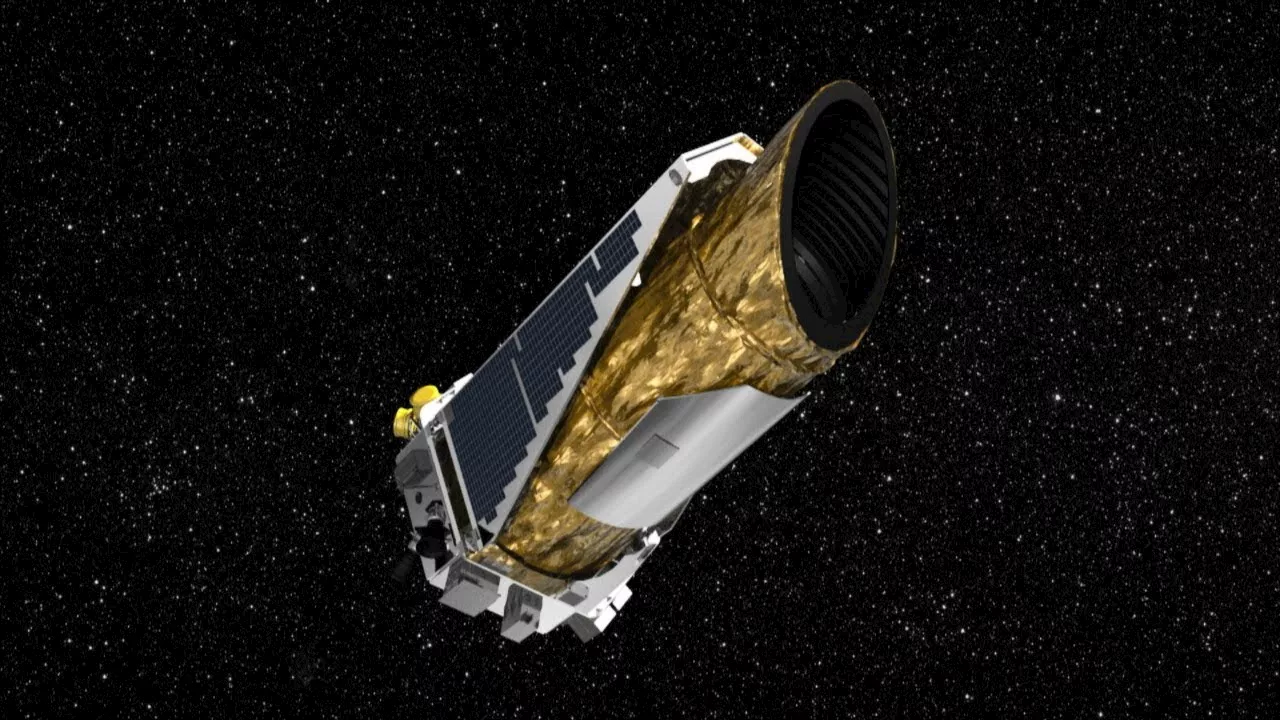 Seven New Exoplanet Candidates Discovered in Kepler's Archived DataScientists have unearthed seven potential new exoplanet candidates hidden within the vast dataset collected by NASA's Kepler Space Telescope. This discovery underscores the enduring value of publicly accessible scientific data and the potential for groundbreaking findings even after a mission's conclusion.
Read more »
 300 New Intermediate-Mass Black Holes Plus 2500 New Active Black Holes in Dwarf Galaxies DiscoveredAstronomers have discovered a large number of new black holes in dwarf galaxies, including 300 intermediate-mass black holes and 2500 active black holes. These findings offer insights into the evolution and distribution of black holes in the universe.
Read more »
 DESI Found 300 Candidate Intermediate Mass Black HolesDESI found 300 more intermediate mass black hole candidates. That's a huge number and there's even more to come.
Read more »