
A chemist turned science writer, Victoria Corless completed her Ph.D. in organic synthesis at the University of Toronto and, ever the cliché, realized lab work was not something she wanted to do for the rest of her days.
A map of Earth’s gravity. Red indicates areas of the world that exert greater gravitational pull, while blue indicates areas that exert less. A science-grade quantum gravity gradiometer could one day make maps like this with unprecedented accuracy.
Scientists are developing an advanced quantum sensor for low Earth orbit that can detect the tiniest tremors in Earth's gravity.The new device could allow the mapping of underground features like aquifers and mineral deposits — crucial data for navigation, resource management andEuropean 'Swarm' satellites detect electric currents from the ocean's tidesQuantum sensors, like the Quantum Gravity Gradiometer Pathfinder instrument developed by JPL, private companies and academic institutions, use clouds of atoms dropped in freefall and cooled to near As they fall, lasers act like mirrors and splitters, separating the atoms and then bringing them back together. The way the atoms interfere when they recombine reveals how much they were accelerated byBreaking space news, the latest updates on rocket launches, skywatching events and more!Receive email from us on behalf of our trusted partners or sponsors These cutting-edge tools, based on a technique called atom interferometry, are far more sensitive than traditional instruments — and they're still improving. Researchers are now refining the technology to make it even more accurate and durable. "With atoms, I can guarantee that every measurement will be the same. We are less sensitive to environmental effects," Sheng-wey Chiow, an experimental physicist at JPL, said in the same statement. New quantum computer smashes 'quantum supremacy' record by a factor of 100 — and it consumes 30,000 times less powerBecause it uses atoms instead of bulky mechanical parts, the QGGPf sensor is surprisingly compact — about the size of a small washing machine — and weighs just 275 pounds . That makes it much smaller and lighter than traditional space-based gravity instruments, which is a big advantage for space missions, where size, weight and launch costs are tightly constrained. NASA plans to give the new sensor an in-space test near the end of the decade. The technology demonstration mission will put a suite of cutting-edge tools to the test, pushing the limits of how light and atoms interact at the smallest scales. "No one has tried to fly one of these instruments yet," said Ben Stray, a postdoctoral researcher at JPL."We need to fly it so that we can figure out how well it will operate, and that will allow us to not only advance the quantum gravity gradiometer, but also quantum technology in general."to keep talking space on the latest missions, night sky and more! And if you have a news tip, correction or comment, let us know at: A chemist turned science writer, Victoria Corless completed her Ph.D. in organic synthesis at the University of Toronto and, ever the cliché, realized lab work was not something she wanted to do for the rest of her days. After dabbling in science writing and a brief stint as a medical writer, Victoria joined Wiley’s Advanced Science Newswhere she works as an editor and writer. On the side, she freelances for various outlets, including Research2Reality and Chemistry World.US and UK militaries pick Rocket Lab's HASTE launcher to help test hypersonic tech The best value VR headset, the Meta Quest 3, is now at its lowest-ever price, perfect if you want a bargain or to explore the world of virtual reality for less The original 'Star Wars' theatrical cut is coming back to theaters... well, one theater... for one night only
United States Latest News, United States Headlines
Similar News:You can also read news stories similar to this one that we have collected from other news sources.
 NASA reveals a sunset on the moon in high definition for the 1st timePandora is the trending news editor at Live Science. She is also a science presenter and previously worked as Senior Science and Health Reporter at Newsweek. Pandora holds a Biological Sciences degree from the University of Oxford, where she specialised in biochemistry and molecular biology.
Read more »
 US Space Force celebrates return of 1st Guardian to launch to space (photos)Julian Dossett is a freelance writer living in Santa Fe, New Mexico. He primarily covers the rocket industry and space exploration and, in addition to science writing, contributes travel stories to New Mexico Magazine. In 2022 and 2024, his travel writing earned IRMA Awards. Previously, he worked as a staff writer at CNET.
Read more »
 James Webb Space Telescope captures 1st images of Neptune's elusive aurorasA chemist turned science writer, Victoria Corless completed her Ph.D. in organic synthesis at the University of Toronto and, ever the cliché, realized lab work was not something she wanted to do for the rest of her days.
Read more »
 China and Pakistan agree to fly 1st foreign astronaut to Chinese space stationJulian Dossett is a freelance writer living in Santa Fe, New Mexico. He primarily covers the rocket industry and space exploration and, in addition to science writing, contributes travel stories to New Mexico Magazine. In 2022 and 2024, his travel writing earned IRMA Awards. Previously, he worked as a staff writer at CNET.
Read more »
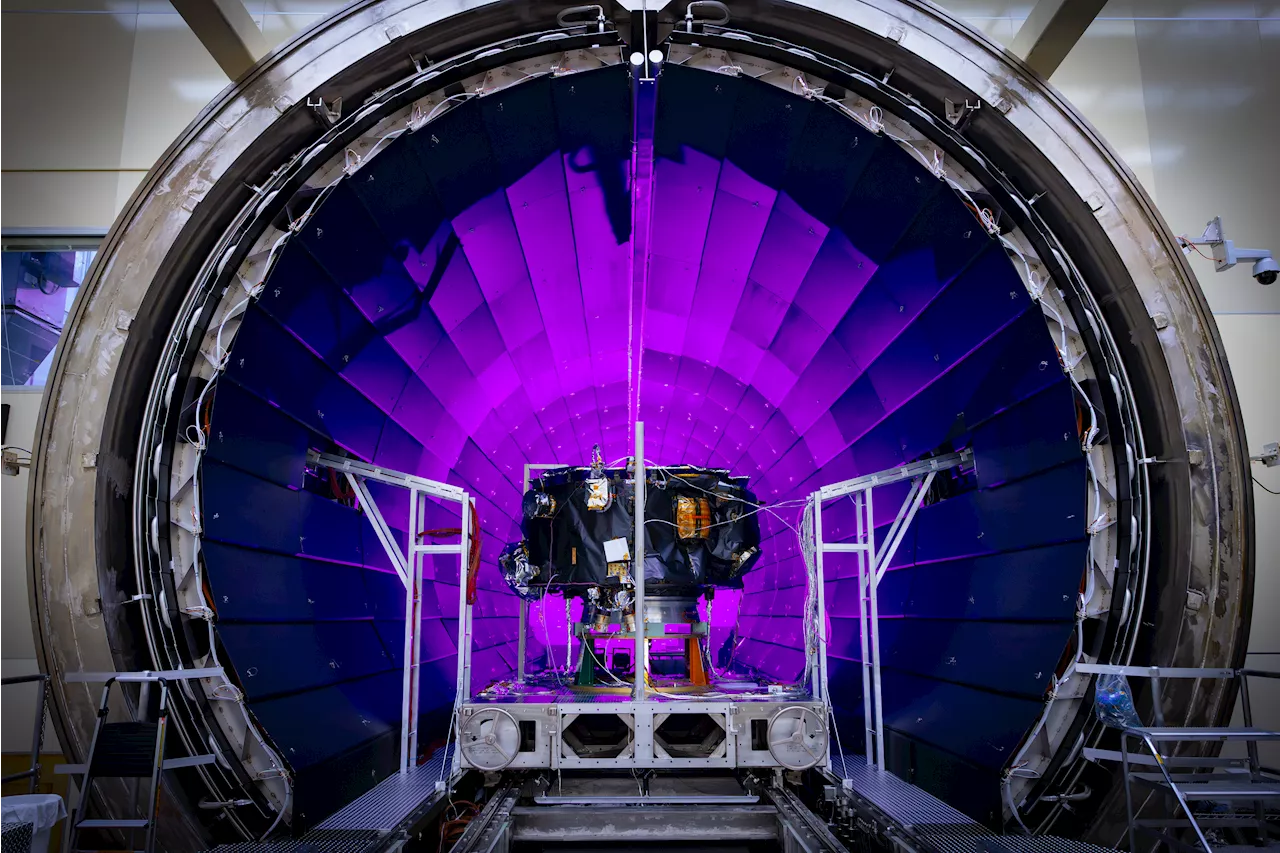 NASA’s IMAP Arrives at NASA Marshall For Testing in XRCFNASA’s IMAP mission arrives at NASA Marshall Space Flight Center. Teams will use Marshall's XRCF thermal vacuum chamber where the spacecraft will undergo testing such as dramatic temperature changes to simulate the harsh environment of space.
Read more »
 Trump Planning Brutal Cuts to NASA: 'Extinction-Level Event for NASA Science'Science and Technology News and Videos
Read more »