
Since last fall, NASA scientists have flown an advanced 3D Doppler wind lidar instrument across the United States to collect nearly 100 hours of data —
Since last fall, NASA scientists have flown an advanced 3D Doppler wind lidar instrument across the United States to collect nearly 100 hours of data — including a flight through a hurricane. The goal? To demonstrate the unique capability of the Aerosol Wind Profiler instrument to gather extremely precise measurements of wind direction, wind speed, and aerosol concentration – all crucial elements for accurate weather forecasting.
Weather phenomena like severe thunderstorms and hurricanes develop rapidly, so improving predictions requires more accurate wind observations. “There is a lack of global wind measurements above Earth’s surface,” explained Kris Bedka, the AWP principal investigator at NASA’s Langley Research Center in Hampton, Virginia. “Winds are measured by commercial aircraft as they fly to their destinations and by weather balloons launched up to twice per day from just 1,300 sites across the globe. From space, winds are estimated by tracking cloud and water vapor movement from satellite images.” However, in areas without clouds or where water vapor patterns cannot be easily tracked, there are typically no reliable wind measurements. The AWP instrument seeks to fill these gaps with detailed 3D wind profiles. The AWP instrument and HALO instrument was integrated onto the floorboard of NASA’s G-III aircraft. Kris Bedka, project principal investigator, sitting in the rear of the plane, monitored the data during a flight on Sept. 26, 2024.emits 200 laser energy pulses per second that scatter and reflect off aerosol particles — such as pollution, dust, smoke, sea salt, and clouds — in the air. Aerosol and cloud particle movement causes the laser pulse wavelength to change, a concept known as the Doppler effect. The AWP instrument sends these pulses in two directions, oriented 90 degrees apart from each other. Combined, they create a 3D profile of wind vectors, representing both wind speed and direction. We are measuring winds at different altitudes in the atmosphere simultaneously with extremely high detail and accuracy.“The Aerosol Wind Profiler is able to measure wind speed and direction, but not just at one given point,” Bedka said. “Instead, we are measuring winds at different altitudes in the atmosphere simultaneously with extremely high detail and accuracy.” Vectors help researchers and meteorologists understand the weather, so AWP’s measurements could significantly advance weather modeling and forecasting. For this reason, the instrument was chosen to be part of the National Oceanic and Atmospheric Administration’s Joint Venture Program, which seeks data from new technologies that can fill gaps in current weather forecasting systems. NASA’s Weather Program also saw mutual benefit in NOAA’s investments and provided additional support to increase the return on investment for both agencies. On board NASA’s Gulfstream III aircraft, AWP was paired with the agency’s High-Altitude Lidar Observatory that measures water vapor, aerosols, and cloud properties through a combined differential absorption and high spectral resolution lidar. Working together for the first time, AWP measured winds, HALO collected water vapor and aerosol data, and NOAA dropsondes gathered temperature, water vapor, and wind data. The AWP and HALO instrument teams observing incoming data on board NASA’s G-III aircraft over Tennessee while heading south to observe Hurricane Helene. Sept. 26, 2024.“With our instrument package on board small, affordable-to-operate aircraft, we have a very powerful capability,” said Bedka. “The combination of AWP and HALO is NASA’s next-generation airborne weather remote sensing package, which we hope to also fly aboard satellites to benefit everyone across the globe.”kris bedkaThe animation below, based on AWP data, shows the complexity and structure of aerosol layers present in the atmosphere. Current prediction models do not accurately simulate how aerosols are organized throughout the breadth of the atmosphere, said Bedka.supports HTML5 video This visualization shows AWP 3D measurements gathered on Oct. 15, 2024, as NASA’s G-III aircraft flew along the East Coast of the U.S. and across the Great Lakes region. Laser light that returns to AWP as backscatter from aerosol particles and clouds allows for measurement of wind direction, speed, and aerosol concentration as seen in the separation of data layers.“When we took off on this particular day, I thought that we would be finding a clear atmosphere with little to no aerosol return because we were flying into what was the first real blast of cool Canadian air of the fall,” described Bedka. “What we found was quite the opposite: an aerosol-rich environment which provided excellent signal to accurately measure winds.” During the Joint Venture flights, Hurricane Helene was making landfall in Florida. The AWP crew of two pilots and five science team members quickly created a flight plan to gather wind measurements along the outer bands of the severe storm.This video shows monitors tracking the AWP science team’s location in the western outer bands of Hurricane Helene off the coast of Florida with views outside of the aircraft looking at turbulent storm clouds on Sept. 26, 2024.“A 3D wind profile can significantly improve weather forecasts, particularly for storms and hurricanes,” said Harshesh Patel, NOAA’s acting Joint Venture Program manager. “NASA Langley specializes in the development of coherent Doppler wind lidar technology and this AWP concept has potential to provide better performance for NOAA’s needs.” The flight plan of NASA’s G-III aircraft – outfitted with the Aerosol Wind Profiler – as it gathered data across the Southeastern U.S. and flew through portions of Hurricane Helene on Sept. 26, 2024. The flight plan is overlaid atop a NOAA Geostationary Operational Environmental Satellite-16 satellite image from that day.The flights of the AWP lidar are serving as a proving ground for possible integration into a future satellite mission. “The need to improve global 3D wind models requires a space-based platform,” added Patel. “Instruments like AWP have specific space-based applications that potentially align with NOAA’s mission to provide critical data for improving weather forecasting.” A view of the outer bands of Hurricane Helene off the coast of Florida during NASA’s science flights demonstrating the Aerosol Wind Profiler instrument on Sept. 26, 2024.
Airborne Science Clouds Earth General Langley Research Center
United States Latest News, United States Headlines
Similar News:You can also read news stories similar to this one that we have collected from other news sources.
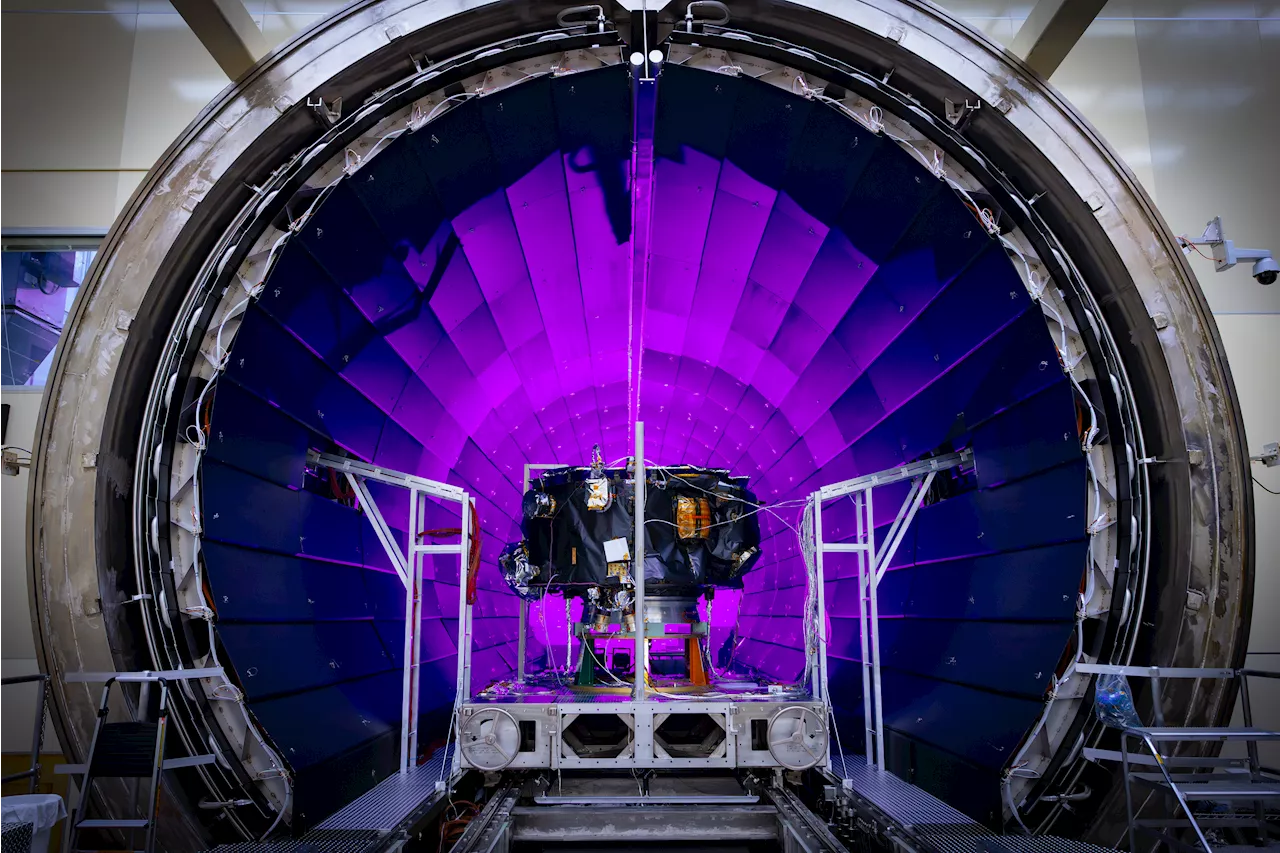 NASA’s IMAP Arrives at NASA Marshall For Testing in XRCFNASA’s IMAP mission arrives at NASA Marshall Space Flight Center. Teams will use Marshall's XRCF thermal vacuum chamber where the spacecraft will undergo testing such as dramatic temperature changes to simulate the harsh environment of space.
Read more »
 Trump Planning Brutal Cuts to NASA: 'Extinction-Level Event for NASA Science'Science and Technology News and Videos
Read more »
 A new robotic gripper made of measuring tape is sizing up fruit and veggie pickingIt's a game a lot of us played as children -- and maybe even later in life: unspooling measuring tape to see how far it would extend before bending. But to engineer, this game was an inspiration, suggesting that measuring tape could become a great material for a robotic gripper.
Read more »
 NASA Studies Wind Effects and Aircraft Tracking with Joby AircraftFor years, NASA has looked at how wind shaped by terrain, including buildings in urban areas, can affect new types of aircraft. The latest test, which is
Read more »
 Buildings shaken and more than 150 people injured as earthquake measuring 6.2 hits IstanbulAn earthquake with a preliminary magnitude of 6.2 has shaken Istanbul and other areas in Turkey.
Read more »
 Solar wind might be making water on the moon, groundbreaking NASA study revealsDamien Pine (he/him) is a freelance writer, artist, and former NASA engineer. He writes about science, physics, tech, art, and other topics with a focus on making complicated ideas accessible. He has a degree in mechanical engineering from the University of Connecticut, and he gets really excited every time he sees a cat.
Read more »