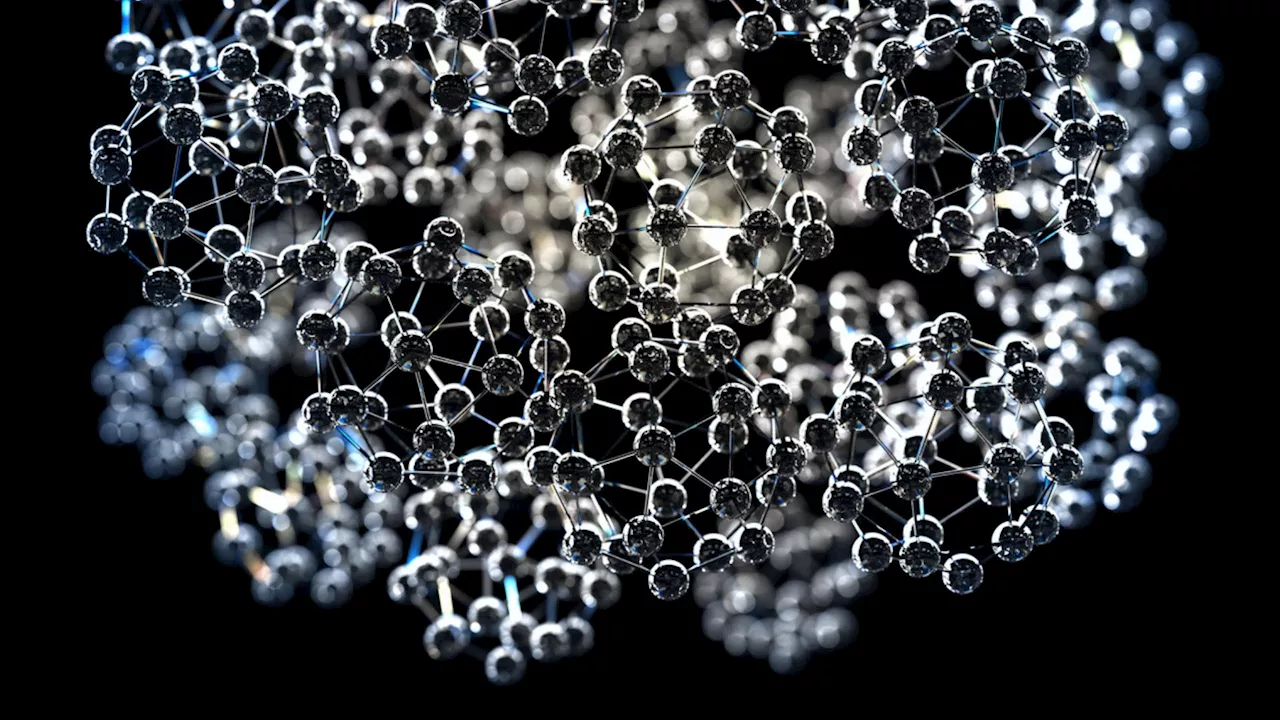
Oregon State University researchers have discovered a new type of nanocrystal that can rapidly switch between light and dark states. This discovery could lead to faster and more energy-efficient computing, particularly in the field of optical computing.
The race for faster, more efficient computing is on. And now, scientists have taken a significant leap forward with the discovery of a unique type of nanocrystal. This has the potential to accelerate artificial intelligence and data processing speed, while also enhancing energy efficiency .
Oregon State University researchers have found luminescent nanocrystals with fast light-dark switching capabilities. “The extraordinary switching and memory capabilities of these nanocrystals may one day become integral to optical computing – a way to rapidly process and store information using light particles, which travel faster than anything in the universe,” said Artiom Skripka, assistant professor in the OSU College of Science. Optically bistable nanocrystals can store information that is written and read entirely through light. Artiom Skripka, OSU College of ScienceThis nanomaterial utilizes a class of materials called avalanching nanoparticles. Nanomaterials are incredibly small particles, typically ranging in size from one-billionth to one-hundred-billionth of a meter. Avalanching nanoparticles are a specific type of nanomaterial with a unique characteristic: they exhibit extreme non-linearity in their light emission. This means that a small increase in the intensity of the laser used to excite them can cause a dramatic surge in the intensity of the light they emit.These nanocrystals, on their own, do not interact with light. However, when “doped” with neodymium, they act as hosts for the neodymium ions. This doping enhances the neodymium ions’ ability to interact with and process light signals. This improved light handling makes these nanocrystals valuable for various optical applications, such as optoelectronics and laser technology. “Normally, luminescent materials give off light when they are excited by a laser and remain dark when they are not,” Skripka explained. “In contrast, we were surprised to find that our nanocrystals live parallel lives. Under certain conditions, they show a peculiar behavior: They can be either bright or dark under exactly the same laser excitation wavelength and power.”Nanocrystals exhibit a fascinating phenomenon known as “intrinsic optical bistability.” Intrinsic optical bistability could pave the way for photonic integrated circuits that could surpass current electronic and optoelectronic systems in both speed and efficiency “If the crystals are dark to start with, we need a higher laser power to switch them on and observe emission, but once they emit, we can observe their emission at lower laser powers than we needed to switch them on initially,” Skripka said. “It’s like riding a bike – to get it going, you have to push the pedals hard, but once it is in motion, you need less effort to keep it going. And their luminescence can be turned on and off really abruptly, as if by pushing a button,” the author explained. demonstrate low-power switching capabilities. This development may help minimize energy consumption, especially in sectors such as artificial intelligence, data centers, and “Integrating photonic materials with intrinsic optical bistability could mean faster and more efficient data processors, enhancing machine learning algorithms and data analysis. It could also mean more efficient light-based devices of the type used in fields like telecommunications, medical imaging, and environmental sensing,” Skripka noted in theThe study was done in collaboration with Lawrence Berkeley National Laboratory, Columbia University, and the Autonomous University of Madrid. Mrigakshi is a science journalist who enjoys writing about space exploration, biology, and technological innovations. Her work has been featured in well-known publications including Nature India, Supercluster, The Weather Channel and Astronomy magazine. If you have pitches in mind, please do not hesitate to email her.
Nanotechnology Computing Artificial Intelligence Data Processing Energy Efficiency
United States Latest News, United States Headlines
Similar News:You can also read news stories similar to this one that we have collected from other news sources.
 Researcher creates 30% stronger concrete using nanocrystals and nanofibersResearchers created concrete reinforced with nanocrystals that is 30 percent stronger than traditional cement.
Read more »
 Nvidia CEO Huang Sees AI as a Major Reset in Computing, Pitches Global GovernmentsNvidia CEO Huang, speaking at The Big Interview event, described AI as a transformative trend that is reshaping computing, akin to the energy and communications infrastructure. He also discussed his global efforts to encourage governments to develop their own AI infrastructure, a pitch that has seen success in at least ten countries.
Read more »
 A New Way Of Computing – Breakthroughs In Photonic And Quantum OperationsWe’re getting new advances in processing to complement all of the important things that LLMs and AI agents are doing.
Read more »
 Why Keanu Reeves Was Not In Speed 2 And What Happened To His Jack Traven CharacterKeanu Reeves in Speed with Jason Patric and Sandra Bullock from Speed 2.
Read more »
 Justice League's New Starship Gets Speed Force BoostThe Justice League's newest spaceship, the JL-657, utilizes the Speed Force to achieve incredible speeds, surpassing even the Batmobile. This technological marvel was designed with contributions from Batman and the Flash, combining their expertise for efficient space travel.
Read more »
 Possible Northwest High-Speed Rail Route Gets $50 Million BoostSpeaking to Newsweek a campaign group said: 'This is an important step forward for high-speed rail in the U.S.'
Read more »