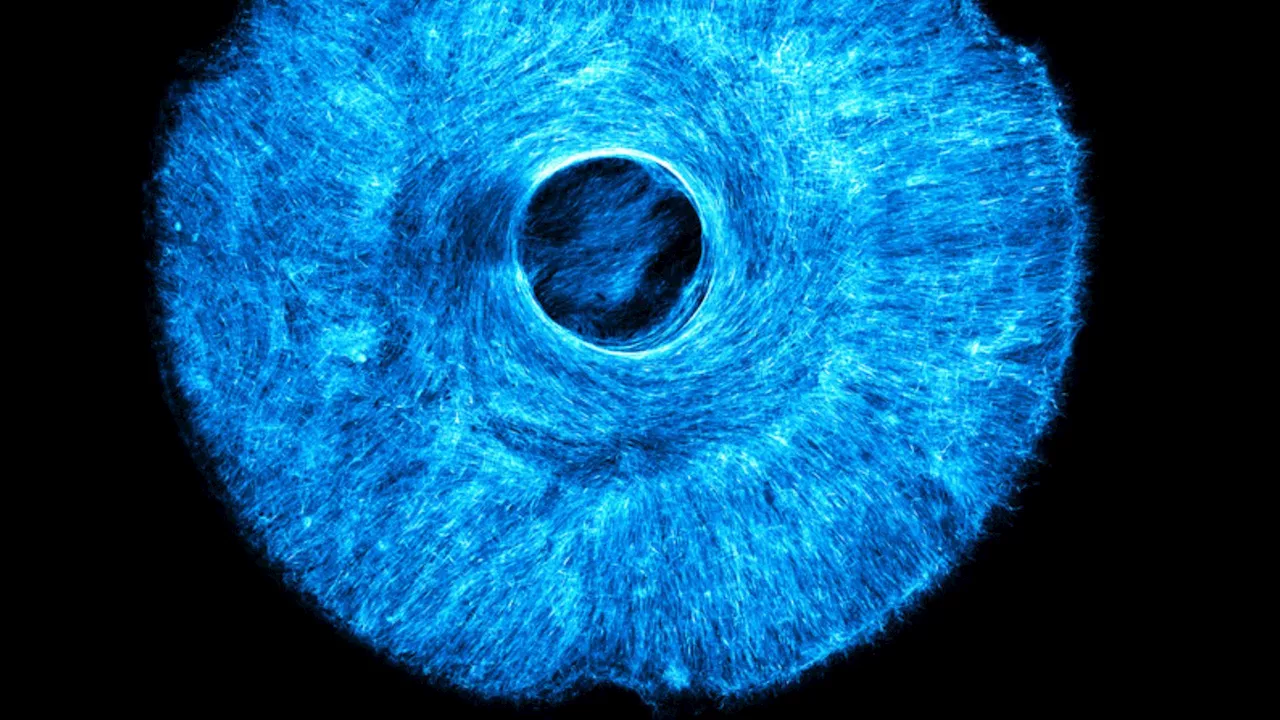
The flexibility of biohybrid robots could allow them to squeeze and twist through areas that are too small or complex.
It has been a long endeavor to create biohybrid robots – machines powered by lab-grown muscle as potential actuators. The flexibility of biohybrid robots could allow them to squeeze and twist through areas that are too small or complex.
But there’s been a major hurdle. Existing artificial muscles can only pull in one direction, which limits their movement. It’s like a robot that can only flex its arm but never rotate it.Researchers at MIT have cracked this code to create a complex, multi-directional motion robotic system. They have showcased artificial muscle that can move in multiple directions, mimicking the iris of an eye. To prove their concept, they created a muscle-powered structure that contracts both in a circle and outwards. Stamping technique A new technique “stamping” was applied to create an artificial iris-like structure. For this, they 3D-printed a tiny stamp, patterned with microscopic grooves. This stamp is then pressed into a soft hydrogel to create a blueprint for muscle growth. Real muscle cells are then seeded into these grooves to grow into fibers. Upon stimulation, the muscles contracted, which moved the fibers in various directions. “With the iris design, we believe we have demonstrated the first skeletal muscle-powered robot that generates force in more than one direction. That was uniquely enabled by this stamp approach,” said Ritu Raman, the Eugene Bell Career Development Professor of Tissue Engineering in MIT’s Department of Mechanical Engineering.Raman’s lab has been developing techniques to cultivate and train lab-grown muscle cells. However, creating artificial muscles with predictable, multi-directional movement has remained a major challenge.“One of the cool things about natural muscle tissues is, they don’t just point in one direction. Take for instance, the circular musculature in our iris and around our trachea. And even within our arms and legs, muscle cells don’t point straight, but at an angle,” Raman noted. “Natural muscle has multiple orientations in the tissue, but we haven’t been able to replicate that in our engineered muscles,” she added. Artificial muscles move like irisThe team 3D-printed a small, handheld stamp with extremely fine grooves, sized to match individual muscle cells. To ensure a clean imprint and prevent damage, the researchers coated the stamp with a protein before pressing it into the hydrogel. This protein layer facilitated an even transfer of the pattern and allowed the stamp to be removed without sticking or tearing the delicate gel.To showcase their stamping technique, the team created a human iris’s muscle structure. It has circular and radial muscle fibers, allowing it to dilate and constrict. After imprinting the iris pattern onto a hydrogel, the researchers introduced genetically modified cells that respond to light. Within 24 hours, these cells settled into the grooves of the imprint, began fusing to form muscle fibers, and followed the precise iris-like pattern.The artificial iris contracted in multiple directions like a real iris when stimulated with light. This showcased the ability to create complex, multi-directional muscle tissue.“In this work, we wanted to show we can use this stamp approach to make a ‘robot’ that can do things that previous muscle-powered robots can’t do. We chose to work with skeletal muscle cells. But there’s nothing stopping you from doing this with any other cell type,” Raman added in the press release.The findings were published in the journal Biomaterials Science.
Biology Flexible Robots Inventions And Machines MIT Robots Soft Robot
United States Latest News, United States Headlines
Similar News:You can also read news stories similar to this one that we have collected from other news sources.
 Robot Chicken to Return for New 20th Anniversary SpecialRobot Chicken is celebrating its 20th anniversary with a brand new special coming this Summer
Read more »
 Eufy’s Top Robot Vacuum Just Dropped to Nearly 50% Off, Way Cheaper Than Dyson Stick VacuumThis Eufy Robot Vacuum 11S Max is compact, quiet, and going for 44% off.
Read more »
 Dyson is offering $200 off its new 360 Vis Nav™ robot vacuum this week360 Vis Nav™ robot vacuum
Read more »
 Humanoid robot springs to life in 'dystopian' viral video: 'Straight out of science fiction'Company creates 'synthetic human' robot that comes to life
Read more »
 Humanoid robot rises from falls like rebels straight out of The Matrix movieResearchers developed HUMANUP, enabling humanoid robots to autonomously get up after falling, boosting robot autonomy.
Read more »
 10 Best Movies Like FlowImagery-from-Flow,-The-Wild-Robot-and-Wall-E
Read more »