
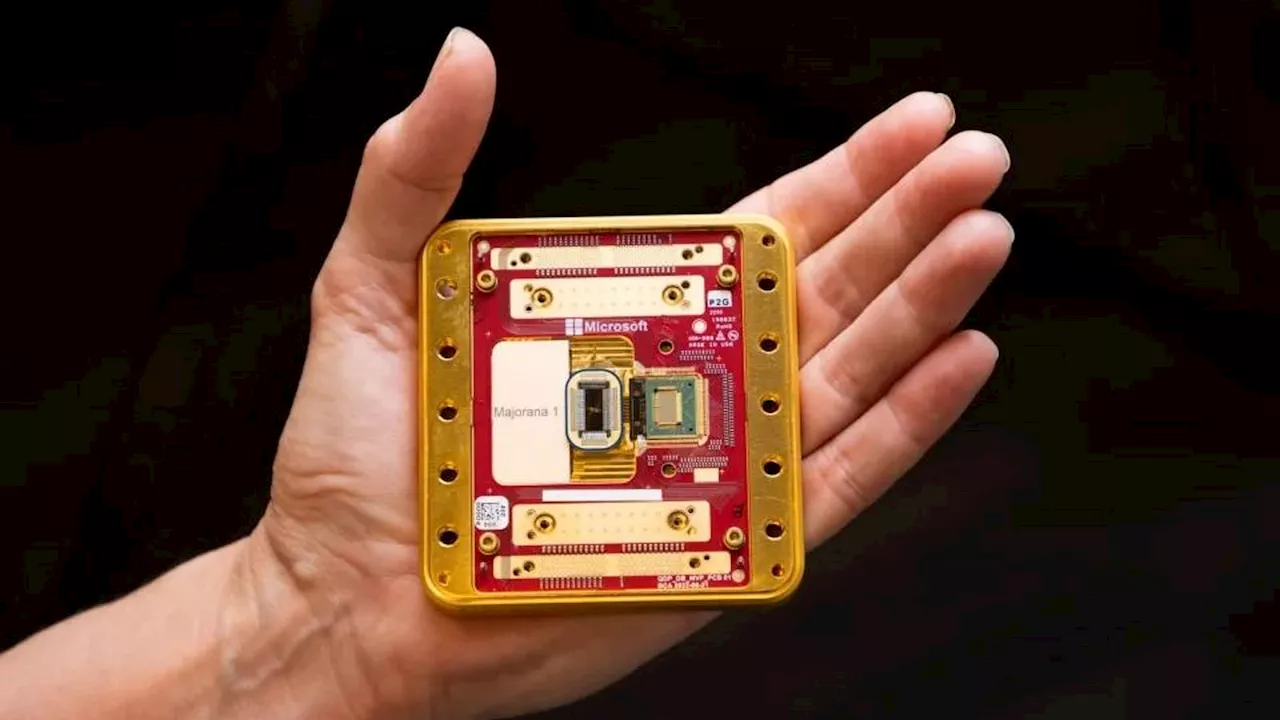
Researchers have criticised Microsoft's new Majorana 1 quantum computer, saying it has made claims about the way it works that aren't fully backed up by scientific evidence
But since then, the tech giant has increasingly come under fire from researchers who say it has done nothing of the sort. “My impression is that the response of the expert physics community has been overwhelmingly negative.
Privately, people are just outraged,” says Microsoft’s claim rests on elusive and exotic quasiparticles called Majorana zero modes . These can theoretically be used to create a topological qubit, a new type of quantum bit – the building blocks of information processing within a quantum computer. Because of their inherent properties, such qubits could excel at reducing errors, addressing a big shortcoming of all quantum computers in use today. MZM’s have been theorised to emerge from the collective behaviour of electrons at the edges of thin superconducting wires. Microsoft’s new Majorana 1 chip contains several such wires and, according to the firm, enough MZMs to make eight topological qubits. A Microsoft spokesperson toldYet researchers say Microsoft hasn’t provided enough evidence to support these claims. Alongside its press announcement, the company published a paper in the journalpaper marks peer-reviewed confirmation that Microsoft has not only been able to create Majorana particles, which help protect quantum information from random disturbance, but can also reliably measure that information from them,”made it explicitly clear that this statement is incorrect. A publicly available report on the peer-review process states: “The editorial team wishes to point out that the results in this manuscript do not represent evidence for the presence of Majorana zero modes in the reported devices.”Hundreds of quantum computing firms around the world are racing to commercialise these once-exotic devices, but the jury is still out on who is going to pull ahead and produce a machine that actually does something useful This isn’t the only unorthodox aspect of Microsoft’s paper. Legg points out that two of the four peer reviewers initially gave rather critical and negative feedback which, in his experience, would typically disqualify a paper from publication in the prestigious journal. The peer-review report shows that by the last round of editing, one reviewer still disagreed with publication of the paper, while the other three signed off on it. A spokesperson forthat the ultimate decision to publish came down to the potential they saw for experiments with future MZMs in Microsoft’s device, rather than necessarily what it had achieved so far.could choose a referee that only a few years ago had a paper retracted,” says Legg. Zhang says there was no conflict of interest. “I have never been an employee of Microsoft, nor was I affiliated to . Among the 100+ authors of the recent Microsoft paper, I have worked with three of them before,” he says. “That was seven years ago, and at that time, they were students of TU Delft , not Microsoft employees.” Microsoft says its team wasn’t involved in selecting reviewers and wasn’t aware of Zhang’s participation until after the review process was complete.also stands by the decision, with a spokesperson saying “the quality of the advice received can be seen from the reviewers’ comments”.With an investment of AU$1 billion, PsiQuantum is planning to build a photonic quantum computer with a million qubits, far larger than any in existence today – and the firm says it will be ready in just two years Review issues aside, both Legg and Frolov have more fundamental objections to Microsoft’s methodology. Experiments with MZMs have proven extremely difficult to perform over the past few decades, because imperfections and disorder in the device can produce spurious signals that mimic the quasiparticles, even if they aren’t present. This has been a challenge for researchers associated with Microsoft, including in the retracted 2018 paper – the retraction notice explicitly references new insights concerning the effects of disorder. To address this, in 2023, Microsoft“The whole idea of this protocol was that it’s a binary test for whether or not there’s Majoranas there,” says Legg. Histhat Microsoft used to implement this protocol in 2023, however, showed it to be less reliable than expected, with a data formatting change being enough to turn a fail into a pass. Legg says he raised these issues with Microsoft before the publication of its’s spokesperson says that the journal’s editorial team is “aware that some have called into question the validity of the topological gap protocol used in thepaper and other publications. This was an issue that we were also aware of during the peer-review process.” Through that process, reviewers determined that this wasn’t a key issue after all, says the spokesperson.“The criticism can be summarised as Legg constructing a false straw man of our paper and then attacking that,” said Chetan Nayak at Microsoft. He disputes Legg’s work on several points and says that the 2023 paper “showed that we could create the topological phase and Majorana zero modes with high confidence” and the new paper only strengthens those claims.paper was submitted for review, the firm has built on that confidence and not only created a multi-qubit chip, but also tested ways to manipulate those qubits, as would be required for a working topological quantum computer. The firm will be releasing further details at the American Physical Society’s Global Physics Summit in March, says the spokesperson. “We look forward to sharing our results along with additional data behind the science that is turning our 20-plus-year vision for quantum computing into a tangible reality.” But for Frolov, the claim that imperfect results from the past can be neglected because the firm has gone on to build more sophisticated devices rests on faulty logic. Legg shares this view. “Fundamental problems of disorder and material science aren’t going to go away just because you start fabricating some fancier device,” he says.
United States Latest News, United States Headlines
Similar News:You can also read news stories similar to this one that we have collected from other news sources.
 Microsoft Unveils Majorana 1: A Groundbreaking Quantum Computing ChipMicrosoft has taken a giant leap forward in quantum computing with the development of Majorana 1, a revolutionary chip that utilizes a Topological Core architecture and Majorana Zero Modes for unparalleled stability and performance.
Read more »
 Microsoft’s Majorana 1: What a new state of matter means for quantum computingBy integrating topoconductors and Majorana particles, Microsoft has mapped out a viable route to a million-qubit quantum chip
Read more »
 Microsoft Unveils Breakthrough Quantum Processor, Majorana 1Microsoft announces a major breakthrough in quantum computing with the unveiling of Majorana 1, its first quantum processor based on a novel architecture using Majorana particles. This technology has the potential to create more reliable qubits and eventually scale to a million qubits on a single chip, opening doors for solving complex industrial-scale problems across various fields.
Read more »
 Microsoft’s Majorana 1: A Step Closer To Quantum Computing SingularityMicrosoft’s Majorana 1 just changed the quantum game. Could this breakthrough bring us closer to singularity faster than we thought?
Read more »
 Microsoft Unveils Majorana 1, Its First Quantum Computing ChipMicrosoft has announced Majorana 1, its first quantum computing chip, marking a significant milestone in the company's nearly two-decade-long research in the field. Quantum computers, which utilize qubits capable of operating in multiple states simultaneously, hold the potential to solve complex problems beyond the capabilities of classical computers. While Microsoft won't offer access to Majorana 1 through its Azure cloud platform initially, the chip represents a step towards their goal of achieving a million qubits. Instead, Microsoft plans to focus on research collaborations with universities and national laboratories. Despite the research focus, investors are enthusiastic about quantum computing, with companies like IonQ and Rigetti experiencing significant stock growth.
Read more »
 Satya Nadella says Microsoft's Majorana 1 is a quantum 'breakthrough'Business Insider tells the global tech, finance, stock market, media, economy, lifestyle, real estate, AI and innovative stories you want to know.
Read more »