
Microsoft and its Azure Quantum collaborators keep breaking new ground on research projects that advance different critical aspects of quantum computing.
Microsoft and its collaborators on the Azure Quantum project have been consistently breaking new ground with quantum computing research projects, most recently by quadrupling the number of logical qubits they are able to create.
This is just the latest in a number of important quantum research projects conducted this year that have significantly advanced different critical aspects of quantum computing including qubit count and error correction. In this article I review several of these breakthroughs by Microsoft and its collaborators, Quantinuum and Atom Computing.Before examining details of these research results, it is important to recognize that Microsoft’s past successes have resulted from its heritage as a platform company. Historically, its major technical achievements have been built on and supported by platforms characterized by factors that include integration, scalability, continuous innovation and support for creating and growing developer ecosystems. This is an important issue because quantum computing is a technology whose success is measured in decades. That extended development period requires a platform with those same characteristics.Microsoft’s commitment to quantum is evidenced by its existing products and its long-range plans. In 2019, Microsoft released Azure Quantum as a cloud-based platform equipped with trapped-ion and superconducting hardware provided by partners. Since its inception, Azure Quantum has evolved into a robust platform with a focus on general applications. It offers several modalities fromso that developers can make comparisons between the technologies. The platform also offers a wide range of hardware and software tools useful to a variety of quantum research levels, ranging from the curious investigator to a quantum scientist with deep technical knowledge about quantum.Who Won The VP Debate Last Night? Here’s What Snap Polls And Betting Markets Say.built specifically for chemists and materials scientists . It uses high-performance computing, AI-accelerated computing and quantum tools for advanced research and modeling. It has several advanced features to accelerate scientific discovery. For example, it features Generative Chemistry AI to design, optimize and specify properties for creating new molecules. It also uses Accelerated DFT to solve quantum mechanical chemistry problems to determine molecular properties. However, it is important to recognize that the Azure Quantum Elements platform is built so that custom applications for other scientific domains can snap into it. It is not limited to chemistry and materials science; instead, this focus is based on industry recognition that these domains are the most promising for near-term quantum applications. Microsoft fully expects that other applications, such as life sciences problems, will also find solutions on this platform.about a joint Microsoft and Pacific Northwest National Laboratory research project that used AI and HPC to model 32 million new candidate materials. In simple terms, that project generated new material candidates, then conducted a hyper-accelerated search among them for a more efficient rechargeable battery material that could be used as a potential replacement for lithium-ion. The project successfully screened 32 million candidates in graduated steps until only one suitable material remained.I have been covering Quantinuum since before it emerged from stealth mode to become Honeywell Quantum Solutions, and then after it became the freestanding Quantinuum organization. For its research projects with Microsoft, Quantinuum has used its latest generation Model H2 quantum computer. This system uses an isotope of ytterbium for qubits and barium ions for cooling. It is important to note that Quantinuum uses an advanced trapped-ion architecture called Quantum Charged Coupled Device. QCCD performs high fidelity quantum operations by moving a few ions at a time into one of four zones located in strategic locations on the quantum chip. Zones allow Quantinuum to perform multiple quantum operations in parallel for increased speed and efficiency. In the short term, Quantinuum’s vision is the evolution of a hybrid supercomputer equipped with a hundred or so reliable logical qubits. Over the long term, it plans to scale a hybrid machine to about 1,000 reliable logical qubits that can run applications beyond the capability of today’s classical supercomputers. In 2025, Quantinuum will be introducing a new H-Series quantum computer, Helios, that will increase the number of physical qubits and increase physical qubit fidelity. Those two factors will also allow a wider set of error correcting codes to be used and the use of an increased number of logical qubits. Meanwhile, the Model H2 has great specs: 56 fully connected qubits, a single-qubit gate fidelity of 99.99%, a two-qubit gate fidelity of 99.87% and a quantum volume of 2,097,152.Atom Computing’s first neutral-atom quantum computer was built on a platform that used strontium-87 atoms for qubits. Its choice of qubits has since changed. Its newest quantum computer uses ytterbium atoms capable of scaling to upwards of 1,200 qubits.concluded that ytterbium-171 may be the best overall choice for qubits. For those with an appetite for the physics details, ytterbium-171 has a nuclear spin of 1/2 compared to the strontium-87 isotope, which presents a more complicated spin of 9/2. In plain English, that means ytterbium has only two quantum levels that can be accessed in its lowest state. That makes its states easier to manipulate and easier to measure compared to strontium’s more complicated atomic structure. More levels in a 9/2 spin requires more control fields, which can also create complications and make a strontium-based system more prone to errors. Greatly simplified, Atom Computing uses lasers like tweezers to trap, control and arrange individual ytterbium atoms into an array. For 100 qubits, the array could be 10x10; for 1,225 qubits, it could be 35x35. Note that the array doesn’t have to be square; it can be arranged in other shapes and in 3-D as well. Another key area of co-design is that the array layout can be optimized to Microsoft’s qubit virtualization. Atom Computer’s new ytterbium processor is still in development, and even though a number of research projects with Microsoft have been completed, the results of those experiments have yet to be published.of 800x using qubit virtualization. This method combined Quantinuum’s high-fidelity H2 ion-trap quantum computer with Microsoft’s qubit virtualization system. The two companies scored another first by creating four stable logical qubits out of 30 physical qubits that contributed to the record error rate. Logical qubits are virtual qubits encoded through the use of multiple entangled physical qubits. Errors caused by environmental factors can disrupt a qubit's quantum state. But if an error occurs in a physical qubit, the logical qubit’s state can be restored using information from the other qubits. This breakthrough set the stage for the later development of a greater number of logical qubits and more reliable quantum computers capable of solving problems far beyond the reach of classical machines.hese technologies will add to the ability of Azure Quantum Elements to compress the next 250 years of chemistry into the next 25 years. Generative Chemistry is important for generating novel molecules and applications using AI models trained on hundreds of millions of compounds. Generative chemistry has the ability to suggest methodologies and workflows needed to synthesize candidates over a matter days rather than years, as suggested by the lithium-ion example above that created 32 million candidate materials.allows researchers to expedite and scale chemical discovery pipelines by simulating the quantum-mechanical properties. By integrating a cloud infrastructure and creating new algorithms for GPUs, Accelerated DFT can achieve high-speed calculations without sacrificing accuracy, allowing it to perform an order of magnitude faster than other DFT codes.Using data and experience gained from their earlier qubit research, Microsoft and Quantinuum teamed up again to create 12 logical qubits—a big step up from the four created in April. In this industry-first study, all 12 logical qubits were entangled using an optimized ] code. These results advance quantum’s reliability and scalability, moving the technology closer to solving problems beyond the reach of today’s supercomputers.Some of our most challenging global issues in chemistry, climate change, logistics, pharmaceuticals, real-time financial derivatives and others are far beyond the reach of classical supercomputers. Every advance that is made in quantum computing helps bring these global problems closer to being solved. It is estimated that these types of problems will require an integrated quantum supercomputer scaled to a million or more error-corrected qubits. Using the Azure Quantum compute platform as a model, it appears that Microsoft, Quantinuum and Atom Computing are on a path to reach that goal. While there’s no definitive timeline, it is the totality of quantum computing research that suggests we are getting closer to exponentially scaling logical qubits to the number needed to build truly useful and powerful quantum computers. Absent any unforeseen dramatic breakthroughs, the answer is a steady step-by-step approach of performing one successful problem-solving research project after another. I see Azure Quantum Elements as a signal of what the most powerful and integrated classical-quantum computing technologies will look like in one or two decades. For now, it is a cornerstone in Microsoft’s plan to build supercomputers that will incorporate all of the important compute technologies. Even better, in addition to the positive research outcomes, each company involved has expressed enthusiasm for the collaborative process itself, which contributes significantly to the overall results. Ben Bloom, CEO and founder of Atom Computing, put it this way: “Microsoft has a world-class hardware team. However, we have mainly been working with its software team that has been thinking about quantum error correction for many years. They have a large number of things they want to try on a system like ours. I think there's a backlog of amazing experiments that are just ready to run.” Moor Insights & Strategy provides or has provided paid services to technology companies, like all tech industry research and analyst firms. These services include research, analysis, advising, consulting, benchmarking, acquisition matchmaking and video and speaking sponsorships. Of the companies mentioned in this article, Moor Insights & Strategy currently has a paid business relationship with Atom Computing, Microsoft and Quantinuum.Our community is about connecting people through open and thoughtful conversations. We want our readers to share their views and exchange ideas and facts in a safe space.Insults, profanity, incoherent, obscene or inflammatory language or threats of any kindContinuous attempts to re-post comments that have been previously moderated/rejectedAttempts or tactics that put the site security at riskProtect your community.
Azure Quantum Quantinuum Atom Computing Quantum Quantum Computing
United States Latest News, United States Headlines
Similar News:You can also read news stories similar to this one that we have collected from other news sources.
 Quantum error correction research reveals fundamental insights into quantum systemsAs scientists and researchers increasingly look to quantum computing to aid in complex problem-solving and advance our understanding of the universe—quantum error correction has become a critical area of scientific inquiry.
Read more »
 Prediction: Microsoft Azure To Reach $200 Billion In Revenue By 2028Beth Kindig is the CEO and Lead Tech Analyst for the I/O Fund and delivers weekly in-depth tech stock analysis to her free newsletter subscribers. Sign up here to receive free weekly stock tips. I/O Fund has a cumulative return of 131% since our inception in May 2020, beating Ark and the majority of Wall Street funds.
Read more »
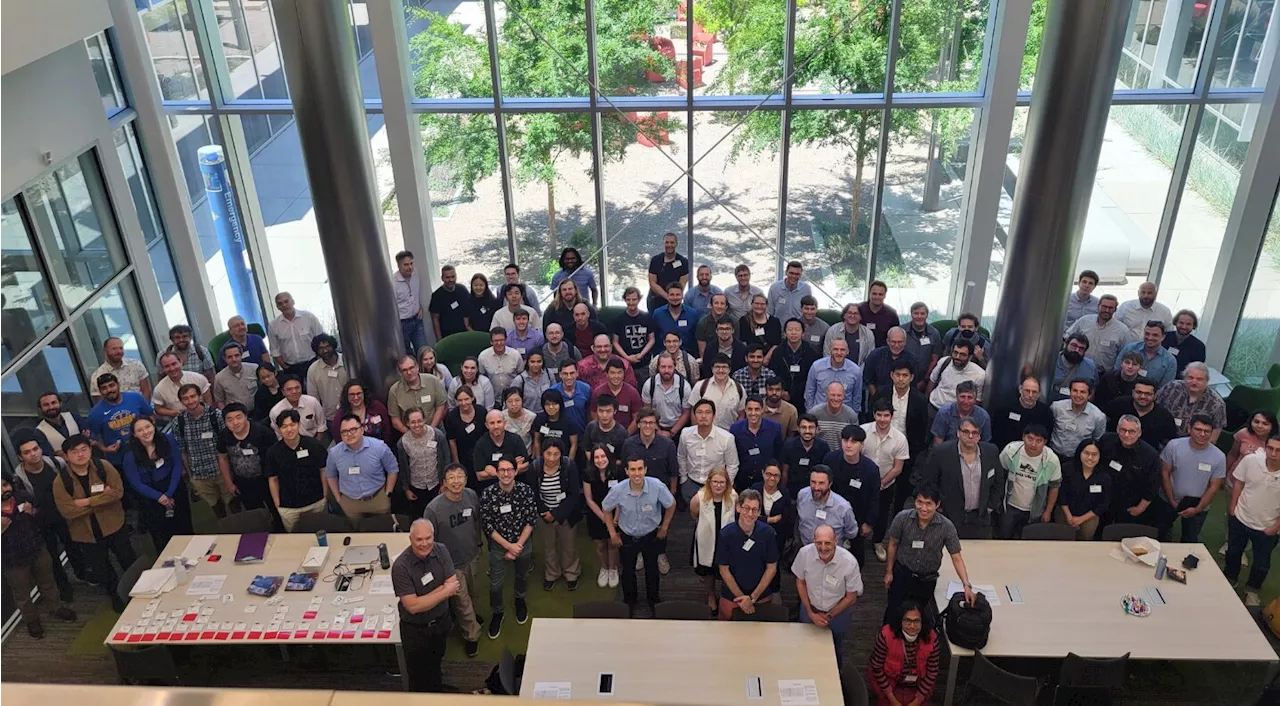 Neutral atom innovations by quantum systems accelerator mark quantum computing milestonesBefore quantum computers can solve complex problems, researchers must develop technologies that manage larger numbers of qubits (the building blocks of quantum computers) for extended periods.
Read more »
 Quantum error correction technology outperforms world's leading quantum computing company, researchers claimSolving the problem of error is essential for the practical application of quantum computing technologies that surpass the performance of digital computers. Information input into a qubit, the smallest unit of quantum computation, is quickly lost and error-prone.
Read more »
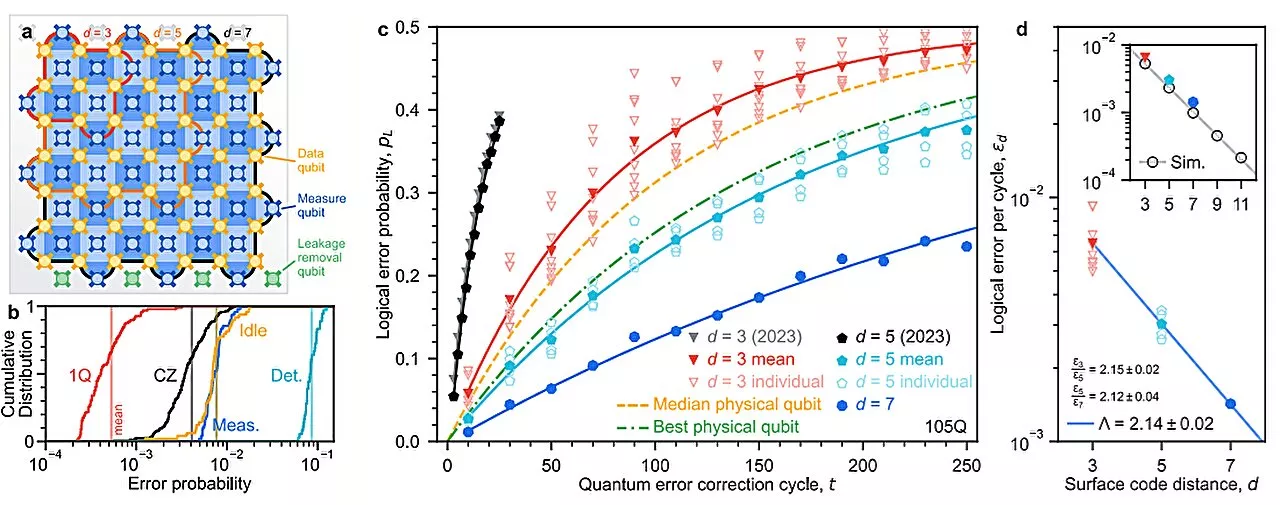 Google Quantum AI demonstrates a quantum memory system that greatly reduces error ratesA team of computer scientists at Google Quantum AI has demonstrated a type of quantum memory for a quantum computer that produces far fewer errors than others. The group has published a paper on the arXiv preprint server describing their new memory system, how it works, and the degree to which it is capable of reducing error rates.
Read more »
 Google Accuses Microsoft of Using Unfair Contracts in Azure Cloud BusinessGoogle filed an antitrust complaint against Microsoft, alleging that the tech giant uses unfair licensing contracts in its Azure cloud computing business to stifle competition. Google claims Microsoft's practices make it difficult for customers to switch to rival cloud providers.
Read more »