Explore the methodology used to analyze user uniqueness on LinkedIn, considering factors like location, skills, and audience size
Authors: Ángel Merino, Department of Telematic Engineering Universidad Carlos III de Madrid {angel.merino@uc3m.es}; José González-Cabañas, UC3M-Santander Big Data Institute {jose.gonzalez.cabanas@uc3m.
es} Ángel Cuevas, Department of Telematic Engineering Universidad Carlos III de Madrid & UC3M-Santander Big Data Institute {acrumin@it.uc3m.es}; Rubén Cuevas, Department of Telematic Engineering Universidad Carlos III de Madrid & UC3M-Santander Big Data Institute {rcuevas@it.uc3m.es}. Table of Links Abstract and Introduction LinkedIn Advertising Platform Background Dataset Methodology User’s Uniqueness on LinkedIn Nanotargeting proof of concept Discussion Related work Ethics and legal considerations Conclusions, Acknowledgments, and References Appendix 4 Methodology 4.1 Location Dimension Using the location may substantially reduce the number of skills that make a user unique on LinkedIn. Because 99.47% of the profiles in our data sample released their location, it does not make sense not to use the location in a nanotargeting campaign in case it is available. Still, some users do not report their location. We aim to analyze both cases and estimate the number of skills that make a user unique when they report their location and when they do not report their location. The initial conditions for the audience size in each of these cases differ. For instance, if we only consider skills, the starting point is the worldwide audience size reported by the LinkedIn Ads manager when carrying out our research, which included 780M users. In contrast, if we also consider the locations, the starting point for a given user is the audience size of the reported location. For instance, at the time of writing this paper, the audience size for the US, the state of New York, and New York City was: 200M, 12M, and 7M, respectively. 4.2 Methodology to compute Np For each user, ui, we leverage the LinkedIn Campaign Manager to obtain the audience size from a combination of N skills with N ranging from 1 to 50. We limit the number of skills to 50 because it is the highest number of skills a user can report on LinkedIn. For N=1, we obtain a vector with 1699 different audience sizes by selecting one skill per user from the skills they have reported in their profile. For N=2, we get another vector with 1699 different audience sizes by selecting two skills per user from the skills they have reported in their profile. We repeat the same operation for N=3, 4, ..., 50. At the end of the process, we have 50 vectors that show the audience size distribution for each value of N. We note the number of users reporting N skills in their profile is lower as N increases. Therefore for a given value of N, the vector will include as many samples as the number of users in our dataset that have reported N or more skills in their profile. Figure 3 shows the vector length for each value of N and the two cases considered in our analysis: skills and location+skills. We acknowledge that the number of samples for N ≥ 30 may be small , but as we will show in the next section, our methodology will not rely on those vectors to compute the number of skills that make a user unique on LinkedIn. 4.3 Skills Selection and Scenarios In this work, we will compare two different strategies. In the first strategy, we randomly select the skills from the skill set. In contrast, the second strategy sequentially adds skills from the least to the most popular. We refer to the former strategy as Random Selection and the latter as Least Popular Selection. Overall, we will apply the described methodology in 4 different scenarios: • Sk_R : In this scenario, we only use the user’s skills, selected following the random strategy. • Sk_LP : In this scenario, we only use the user’s skills, selected following the least popular strategy. • Lo_R : In this scenario, we use the reported location and skills of the user, selected following the random strategy. • Lo_LP : In this scenario, we use the reported location and skills of the user, selected following the least popular strategy. This paper is available on arxiv under CC BY-NC-ND 4.0 DEED license. Authors: Ángel Merino, Department of Telematic Engineering Universidad Carlos III de Madrid {angel.merino@uc3m.es}; José González-Cabañas, UC3M-Santander Big Data Institute {jose.gonzalez.cabanas@uc3m.es} Ángel Cuevas, Department of Telematic Engineering Universidad Carlos III de Madrid & UC3M-Santander Big Data Institute {acrumin@it.uc3m.es}; Rubén Cuevas, Department of Telematic Engineering Universidad Carlos III de Madrid & UC3M-Santander Big Data Institute {rcuevas@it.uc3m.es}. Authors: Authors: Ángel Merino, Department of Telematic Engineering Universidad Carlos III de Madrid {angel.merino@uc3m.es}; José González-Cabañas, UC3M-Santander Big Data Institute {jose.gonzalez.cabanas@uc3m.es} Ángel Cuevas, Department of Telematic Engineering Universidad Carlos III de Madrid & UC3M-Santander Big Data Institute {acrumin@it.uc3m.es}; Rubén Cuevas, Department of Telematic Engineering Universidad Carlos III de Madrid & UC3M-Santander Big Data Institute {rcuevas@it.uc3m.es}. Table of Links Abstract and Introduction Abstract and Introduction LinkedIn Advertising Platform Background LinkedIn Advertising Platform Background Dataset Dataset Methodology Methodology User’s Uniqueness on LinkedIn User’s Uniqueness on LinkedIn Nanotargeting proof of concept Nanotargeting proof of concept Discussion Discussion Related work Related work Ethics and legal considerations Ethics and legal considerations Conclusions, Acknowledgments, and References Conclusions, Acknowledgments, and References Appendix Appendix 4 Methodology 4.1 Location Dimension Using the location may substantially reduce the number of skills that make a user unique on LinkedIn. Because 99.47% of the profiles in our data sample released their location, it does not make sense not to use the location in a nanotargeting campaign in case it is available. Still, some users do not report their location. We aim to analyze both cases and estimate the number of skills that make a user unique when they report their location and when they do not report their location. The initial conditions for the audience size in each of these cases differ. For instance, if we only consider skills, the starting point is the worldwide audience size reported by the LinkedIn Ads manager when carrying out our research, which included 780M users. In contrast, if we also consider the locations, the starting point for a given user is the audience size of the reported location. For instance, at the time of writing this paper, the audience size for the US, the state of New York, and New York City was: 200M, 12M, and 7M, respectively. 4.2 Methodology to compute Np For each user, ui, we leverage the LinkedIn Campaign Manager to obtain the audience size from a combination of N skills with N ranging from 1 to 50. We limit the number of skills to 50 because it is the highest number of skills a user can report on LinkedIn. For N=1, we obtain a vector with 1699 different audience sizes by selecting one skill per user from the skills they have reported in their profile. For N=2, we get another vector with 1699 different audience sizes by selecting two skills per user from the skills they have reported in their profile. We repeat the same operation for N=3, 4, ..., 50. At the end of the process, we have 50 vectors that show the audience size distribution for each value of N. We note the number of users reporting N skills in their profile is lower as N increases. Therefore for a given value of N, the vector will include as many samples as the number of users in our dataset that have reported N or more skills in their profile. Figure 3 shows the vector length for each value of N and the two cases considered in our analysis: skills and location+skills. We acknowledge that the number of samples for N ≥ 30 may be small , but as we will show in the next section, our methodology will not rely on those vectors to compute the number of skills that make a user unique on LinkedIn. 4.3 Skills Selection and Scenarios In this work, we will compare two different strategies. In the first strategy, we randomly select the skills from the skill set. In contrast, the second strategy sequentially adds skills from the least to the most popular. We refer to the former strategy as Random Selection and the latter as Least Popular Selection. Least Popular Selection. Overall, we will apply the described methodology in 4 different scenarios: • Sk_R : In this scenario, we only use the user’s skills, selected following the random strategy. • Sk_R : • Sk_R : • Sk_LP : In this scenario, we only use the user’s skills, selected following the least popular strategy. • Sk_LP • Sk_LP • Lo_R : In this scenario, we use the reported location and skills of the user, selected following the random strategy. • Lo_R : • Lo_R : • Lo_LP : In this scenario, we use the reported location and skills of the user, selected following the least popular strategy. • Lo_LP : • Lo_LP : This paper is available on arxiv under CC BY-NC-ND 4.0 DEED license. This paper is available on arxiv under CC BY-NC-ND 4.0 DEED license. available on arxiv
United States Latest News, United States Headlines
Similar News:You can also read news stories similar to this one that we have collected from other news sources.
 Study reveals uniqueness of naturally occurring monodominant forests in the Republic of CongoA recent study published in the journal Plant Ecology and Evolution gives valuable insights into forest stands of Gilbertiodendron dewevrei (G. dewevrei) in the Sangha Trinational region.
Read more »
 LinkedIn adds 3 games to spark conversation and connectionAs word games continue to dominate the daily internet routine of many, LinkedIn is hoping its versions will spark a conversation among your co-workers, college alumni and other associates.
Read more »
 Building a User-Friendly Interface for Central Bank Digital Currency Applications: A Case StudyI share my experience in designing the interface of a retail CBDC application. Perhaps these technologies will soon compete with traditional banking
Read more »
 Exclusive: Employees are bringing their own AI to workA report from Microsoft and LinkedIn shows the gulf between employees and their managers.
Read more »
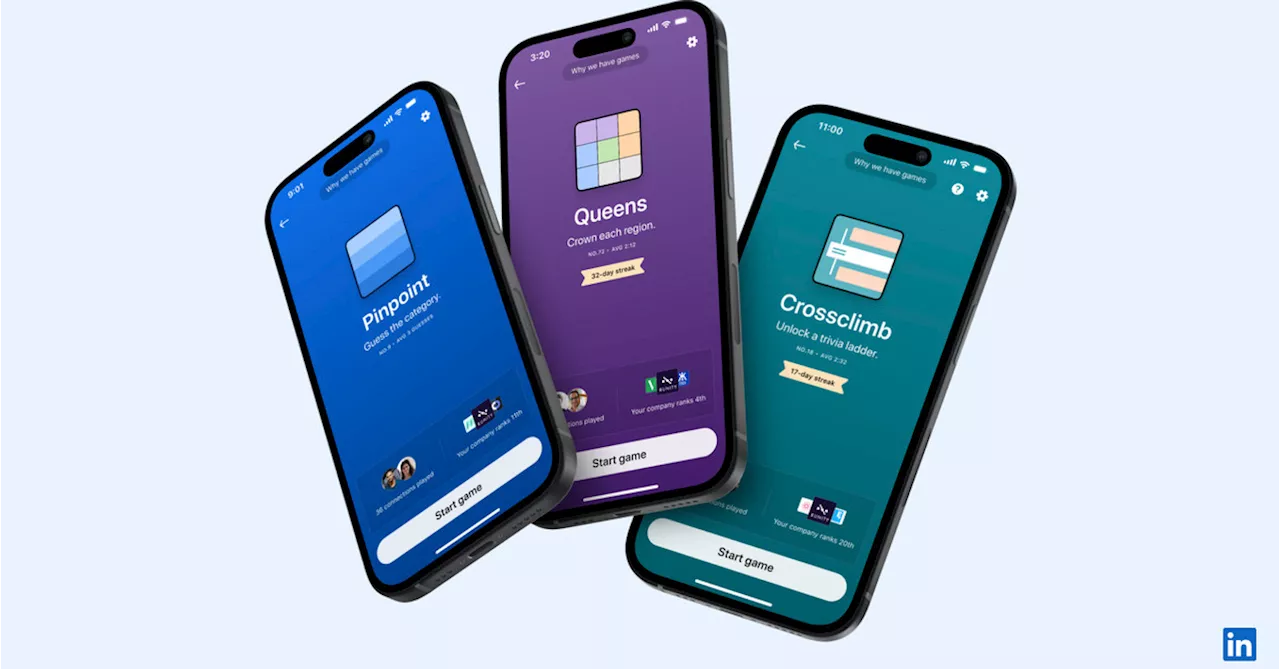 LinkedIn’s new daily games are surprisingly fun to playThe professional social network has three new games: Pinpoint, Crossclimb, and Queens. All three are an unexpected amount of fun.
Read more »
 How Location and Skills Affect LinkedIn User Uniqueness on LinkedInDiscover how location & skills affect LinkedIn user uniqueness, nanotargeting success, & privacy risks in user profiling on the platform.
Read more »