Quantum computing is on the verge of catapulting the digital revolution to new heights.
Turbocharged processing holds the promise of instantaneously diagnosing health ailments and providing rapid development of new medicines; greatly speeding up response time in AI systems for such time-sensitive operations as autonomous driving and space travel; optimizing traffic control in congested cities; helping aircraft better navigate extreme turbulence; speeding up weather forecasting that better prepares localities facing potential disaster, and optimizing supply chain systems for more efficient delivery times and cost savings.
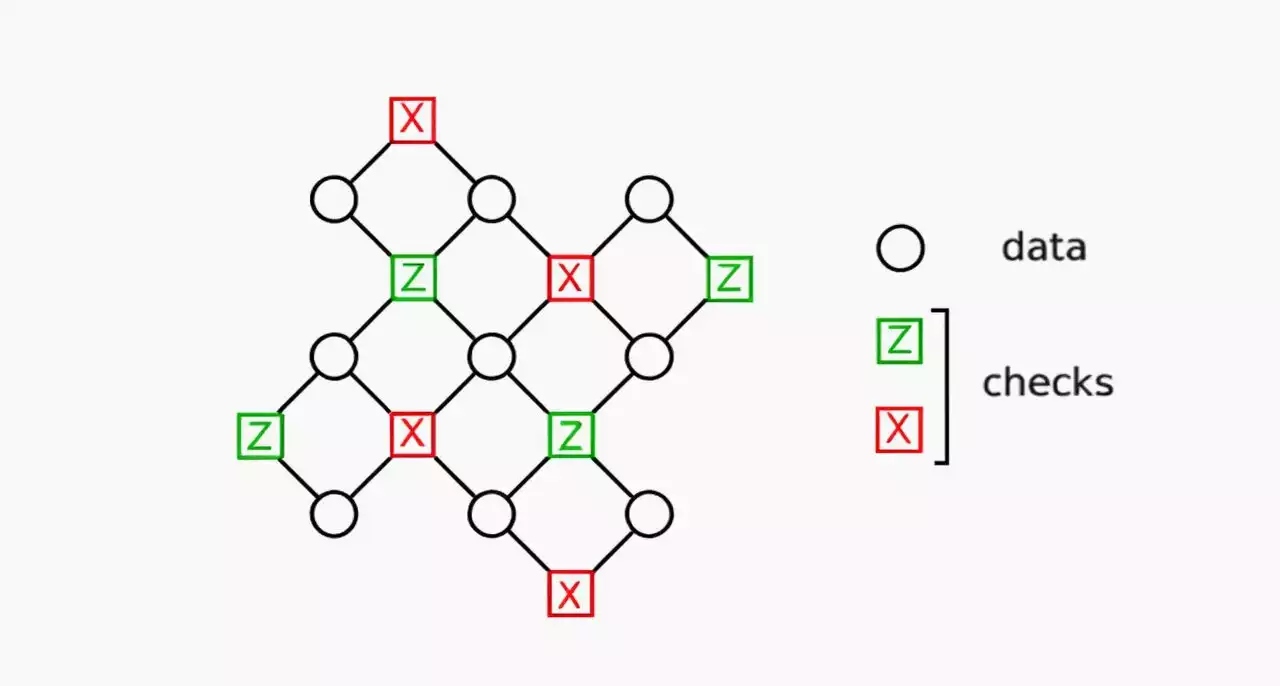
But we're not there yet. One of the greatest obstacles facing quantum operations is error-correction.is a higher error rate. Quantum computers are highly susceptible to noise such as electromagnetic signals, temperature change and disturbances in the Earth's magnetic field. Such noise triggers errors., themselves are prone to error. Faults in frequencies, energy levels and coupling strength can cause miscalculations. Unlike standard computer bits that are copied reliably most of the time, qubits, by their very nature, cannot be cloned without errors being introduced. Bits store easily replicated binary digit states while qubits store data in a complex mathematical quantum state that can be disrupted during copying. Additionally, qubits age quickly and deterioration can introduce errors. Researchers at IBM Quantum say they have developed a system that dramatically improves error-detection in quantum computing. In an online post Aug. 28, they explained the challenge:"Standard classical error-correction only needs to correct bit flip errors," said IBM researcher Sergey Bravyi. "Quantum computers must correct more kinds of errors, like phase errors which can corrupt the extra quantum information that qubits carry … Techniques must [also] correct errors without the ability to copy unknown quantum states, and without destroying the underlying quantum state." In their research paper, IBM researchers described a process they say greatly trims the required arsenal currently used in quantum computing to catch errors. Standard computer surface codes have long been successfully used for error-corrections. These are two-dimensional grids resembling a checkerboard. Efficient error-correction for qubits is more challenging. Bravyi says many experts estimate fault-tolerant quantum computing would require millions of qubits,"a number we believe is too large to be practical at this stage of development." IBM's solution, improved code and a redesign of qubit placement, achieves results requiring one-tenth the number of physical"Practical error correction is far from a solved problem," the researchers acknowledged in a paper titled"High-threshold and low-overhead fault-tolerant quantum memory" published Aug. 15 in the preprint server"However, these new codes and other advances across the field are increasing our confidence that fault tolerant quantum computing isn't just possible, but is possible without having to build an unreasonably large quantum computer.""These techniques are a stepping stone towards a world of fault-tolerant computing," Bravyi says,"and this new … code is bringing that world closer. It's a promising result pointing us where we should look next for even better error correcting codes."Sergey Bravyi et al, High-threshold and low-overhead fault-tolerant quantum memory,
United States Latest News, United States Headlines
Similar News:You can also read news stories similar to this one that we have collected from other news sources.
 First Quantum joins Rio in copper JVDiversified miner Rio Tinto has formed a joint venture (JV) with fellow major First Quantum over the development of the La Granja copper project, in Peru. Following the completion of conditions including regulatory approvals from the government of Peru, First Quantum has acquired a 55% stake in the project for $105-million. It will invest up to a further $546-million into the JV to sole fund capital and operational costs to take the project through a feasibility study and toward development.
Read more »
 Physicists Visualize Quantum Yin-Yang in Entangled Light ExperimentNever let it be said that scientists don't have an eye for the sublime.
Read more »
 Council Post: Unlocking Europe's Quantum Potential: Why The Startup Funding Model Is CriticalEurope stands at a historic crossroads, with the opportunity to cement itself as a global leader in transformative quantum technology.
Read more »
 Chessboard-like method enables the operation of largest gate-defined quantum dot systemResearchers from Delft established a way to address many quantum dots with only a few control lines using a chessboard-like method. This enabled the operation of the largest gate-defined quantum dot system ever. Their result is an important step in the development of scalable quantum systems for practical quantum technology. They publish their results in Nature Nanotechnology.
Read more »
 Quantum computer unveils atomic dynamics of light-sensitive moleculesResearchers have implemented a quantum-based method to observe a quantum effect in the way light-absorbing molecules interact with incoming photons. Known as a conical intersection, the effect puts limitations on the paths molecules can take to change between different configurations. The observation method makes use of a quantum simulator, developed from research in quantum computing, and offers an example of how advances in quantum computing are being used to investigate fundamental science.
Read more »
 Physicists develop series of quality control tests for quantum computersQuantum technologies—and quantum computers in particular—have the potential to shape the development of technology in the future. Scientists believe that quantum computers will help them solve problems that even the fastest supercomputers are unable to handle yet. Large international IT companies and countries like the United States and China have been making significant investments in the development of this technology. But because quantum computers are based on different laws of physics than conventional computers, laptops, and smartphones, they are more susceptible to malfunction.
Read more »