
Flying robots could help build skyscrapers, offering safer, greener alternatives to traditional construction.
UK researchers have claimed that flying robots could build skyscrapers as outstanding as the UAE’s Burj Khalifa or New York’s Empire State Building by reaching heights and locations once deemed impossible.
The study, conducted by Imperial College London and the University of Bristol, explores how drones can perform mid-air material deposition autonomously – a process known as Aerial Additive Manufacturing – marking a significant step forward in aerial construction technology.The approach, which employs aerial robots for unrestricted construction tasks, offers distinct advantages, including scalability at height, access to hard-to-reach locations, and rapid on-demand repairs.According to the scientists, the technology aims to tackle urgent global housing and infrastructure challenges by using aerial robots with advanced manipulators capable of overcoming the limitations of traditional construction methods and ground-based robotics.Drone construction breakthroughAerial robots, unlike traditional construction methods or ground-based systems, operate within an unrestricted work envelope, enabling them to build at greater heights and navigate complex or hard-to-reach terrains that conventional approaches cannot access, whether in the mountains, on rooftops, in disaster areas or even on distant planets.What’s more, they don’t require a fixed construction site, can be deployed in swarms, and offer exceptional flexibility and scalability. At the same time, they could reduce transport distances, cut material consumption, and make construction sites significantly safer.To support this emerging approach, the researchers introduced an autonomy framework tailored for Aerial AM, tackling key challenges like flight coordination, precise material deposition, and scalability for large-scale construction tasks.“Despite promising advancements, the deployment of aerial robots for large-scale autonomous construction remains in its infancy,” Basaran Bahadir Kocer, PhD, a lecturer at University of Bristol’s School of Civil, Aerospace and Design Engineering, and study co-author, says. “Key obstacles include material durability, localization systems for outdoor environments, and coordination among multiple aerial units,” Kocer continues. Robotic arms and 3D printing gantries are already in use on construction sites, but they’re typically heavy, ground-based systems with limited mobility. These setups struggle to perform on uneven terrain or at elevated heights, where flexibility is crucial.“Addressing these challenges is essential to unlocking the full potential of Aerial AM in real-world applications,” Kocer states. “However, early-stage demonstrations of Aerial AM have already showcased capabilities such as rapid on-demand repairs and modular assembly techniques, paving the way for broader adoption across industries.”Real-world trialsThe technology is currently being tested at DroneHub in Switzerland, part of EMPA – the Swiss Federal Laboratories for Materials Science and Technology – offering the first real-world testing platform for flying construction machines outside the lab.Aerial robots are especially well-suited for disaster relief, particularly in flooded or devastated areas where conventional vehicles can’t reach. They could transport building materials and autonomously construct emergency shelters. Their potential also extends to hard-to-reach repair sites, where they could detect and fix cracks on high-rise facades or bridges – no scaffolding required.With aerial robots being especially well-suited for disaster relief, they can access areas unreachable by ground vehicles, deliver materials, build emergency shelters, and perform repairs on high-rise structures without scaffolding. Yusuf Furkan Kaya, a PhD researcher at Empa and EPFL’s Sustainability Robotics Lab and lead author of the study, explains that ground-based robotic systems often weigh several tons, require lengthy setup times, and operate within a limited range.Aerial AM includes three main types: modular unit builds , tensile structures using linear elements , and continuous material deposition .Credit: Empa“Construction drones, on the other hand, are light, mobile and flexible – but so far they only exist at low technology readiness levels,” Kaya explains. “They have yet to be used for industrial purposes.”Without lightweight, stable, and workable materials, the technology cannot reach its full potential. This also means construction designs must be adapted to accommodate the limited precision of aerial robots, ensuring safe and reliable structures.Therefore, the researchers’ autonomy framework includes five stages, ranging from basic route-based flights to full independence, where aerial robots can analyze their environment, detect errors, and adapt designs in real-time. According to Yusuf Furkan Kaya, this is not just a theoretical concept but a practical development roadmap.“Our goal is to have aerial robots that understand what material they are building with and in what environment, and intelligently optimize the resulting structure during construction,” Kaya concludes in a press release.The study has been published in the journal Science Robotics.
Building Construction Drones Innovation Physics Research Robots Science University Of Bristol
United States Latest News, United States Headlines
Similar News:You can also read news stories similar to this one that we have collected from other news sources.
 Drone Pilot Jailed for Four Months for Taking Photos of Space Force BaseA Chinese national has been sentenced to four months in jail for flying a drone over and taking photos of a U.S. Space Force base.
Read more »
 ‘Flying Sun’: Drone turns night into day with stunning 300,000-lumen light beamFreefly Systems’ Flying Sun 1000 mounts 288 LEDs onto an Alta X quadcopter, projecting 300,000 lumens of overhead light
Read more »
 Bug-sized daredevil robot nails aerial stunts, beating flying bots in energy useThe MIT robot uses a springy leg for propulsion and four flapping wings for lift and orientation control.
Read more »
 Alligator-9: Ukraine’s sea demon drone fries enemy robot drones with laser fireUkraine unveils the Alligator-9 naval drone, capable of launching kamikaze swarms or a powerful laser system to destroy UAVs and missiles.
Read more »
 Thailand Rings in New Year With Drone and CCTV-Powered Robot CopAlthough it may have chilling technology like 360-degree AI cameras, the police robot's full potential is unknown.
Read more »
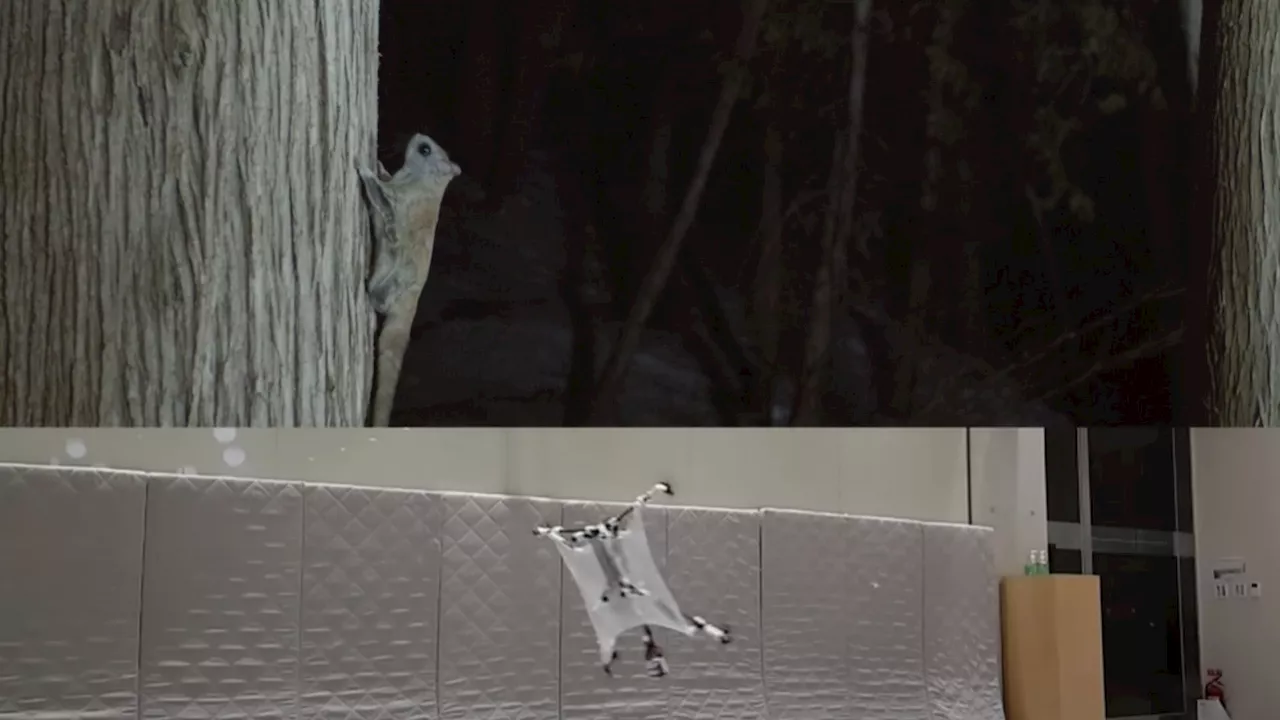 Flying squirrel-style drone with foldable wings tracks 13% better than rivalsInspired by flying squirrels, South Korean team's new drone uses foldable wings to boost agility, improving tracking by 13.1 percent.
Read more »