


 +34
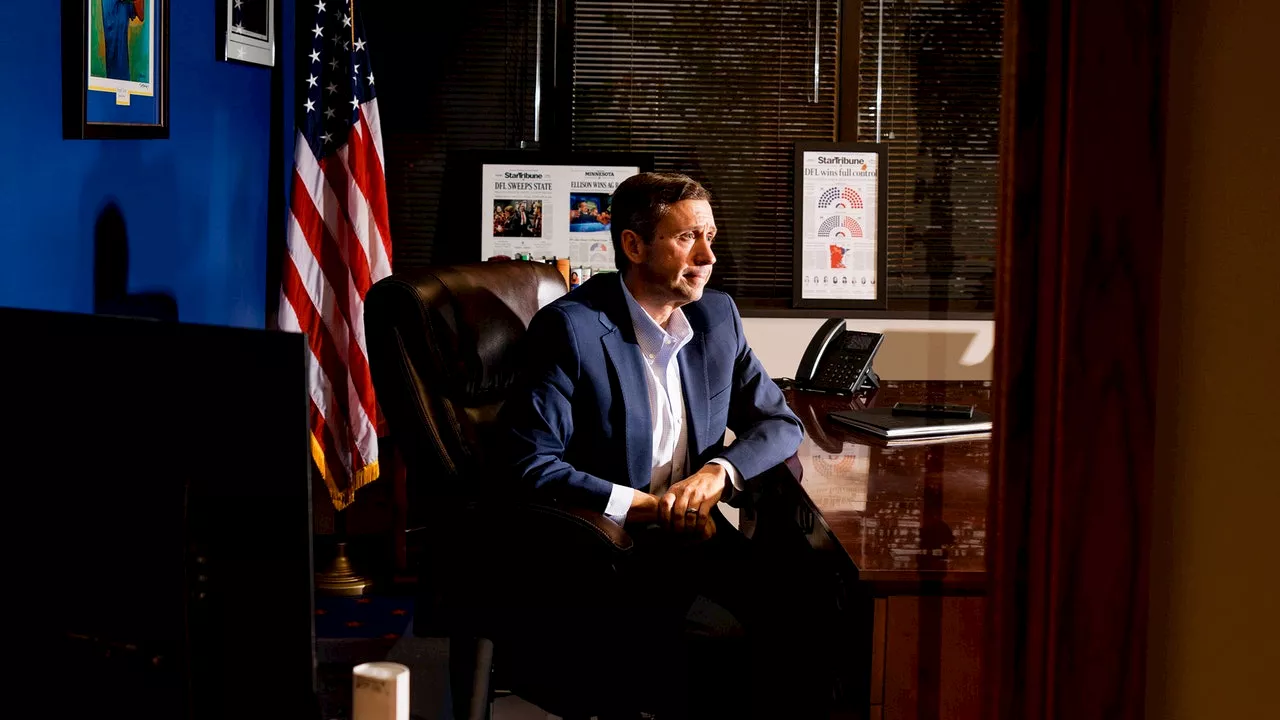
Ken Martin, candidate for DNC chair, discusses the implications of Trump's actions and policies, emphasizing the need for Democrats to build a long-term strategy for success.
As he sees it, the answer to both defeating Trump and making Democrats more competitive down the ballot and across the country is overhauling the Democratic messaging apparatus, expanding campaign infrastructure, and thinking more long term about strategy.
“We have to essentially build to where things will be with a much longer arc than just one election cycle,” says Martin, who has led the Minnesota Democratic-Farmer-Labor Party since 2011. “We can’t just keep focusing on one cycle or one presidential year.” In a conversation, which has been edited for clarity and length, Martin talks about how he’d replicate his success in Minnesota on a national level, how Democrats can fight back against a second Trump term, and how his hopes were dashed in 2024: “We asked Kamala Harris and Tim Walz to do the improbable,” the DNC chair candidate says. Vanity Fair: What have you made of the Trump transition so far? I don’t know if you caught his press conference this week, but what’s been your general impression this time around versus 2016? Ken Martin: Look, none of what we are seeing right now should surprise any of us, right? He told us on the campaign trail what he would do, and he’s doing it. This is a point we tried to make, albeit unsuccessfully, to the American people—that Donald Trump was and continues to be a threat to our democracy and to our democratic institutions. There’s no greater evidence of that than the people that he’s nominating to his Cabinet, who are, by and large, wholly unqualified to hold these positions, and certainly a danger to not only those agencies but the American people. I don’t think it’s hyperbolic to say that what we said on the campaign trail is now coming into focus and into reality. He’s suing a pollster. He’s going after The Des Moines Register for election interference. The American people didn’t vote for any of that. What they wanted was an administration that’s going to help make their lives more affordable and easier to live, and he’s really not focused on any of that. In fact, he’s backtracking on the promise he made to bring down grocery prices, as an example. So I think it’s a responsibility of the Democratic Party, and, frankly, other organizations right now, to stand up and resist the excesses and extremes of the Trump administration—but not to completely live in that space either, right? Because if that’s all we’re doing, then it means we’re not doing the critical work of reestablishing ourselves, reestablishing our brand, and really connecting with voters again. But none of this should surprise anyone at this point. It’s exactly who he is. And you know the Maya Angelou quote: “When people show you who they are, believe them the first time.” So how do Democrats beat him? The party has lost two out of three elections to him at this point, and it feels like things are going backward. In 2016 he started out as a joke to a lot of people. Then he was seen as a threat. Now he’s being treated by a lot of people as somewhat mainstream. It feels like we’re not just recovering from a tough election—it feels like we’re digging out of a really deep hole. I think that’s an accurate assessment. I mean, it was a really close election, as you know. But the reality is, it’s bigger than that. People are deeply concerned. And so, to beat Donald Trump, it’s twofold: One, again, we have to stand up and resist the excesses and extremes of this administration and make sure that people see us fighting back, particularly on some of the more devastating policies that he said he’s going to pursue, which are going to shatter people’s lives and divide communities throughout this nation. But at the same time, we also have a responsibility to give people a sense of who we are as a party and what we’re fighting for. The reality is that a number of people who left the Democratic Party left for a whole host of reasons, but one, as you know—it should have been the canary in a coal mine: There was research that showed for the first time in modern American history the perceptions of the major political parties have changed completely. A majority of Americans now believe that the Republican Party best represents the interest of the working class, and the Democratic Party is a party of the elite and the wealthy. And so we obviously have a branding problem—which is a damning indictment on our party, by the way—and then we also have a messaging problem. But I don’t think we have a message problem. If you look across the country, in this election, there are many ballot initiatives with policies that Democrats champion, from minimum wage to paid family leave to abortion protections to other wildly popular policy initiatives that people were supporting. They were going deep down ballots, after they supported those, and then voted for Trump and Republicans. So clearly, there’s a messaging problem and a branding problem here. I say that because I think when Donald Trump fails the American people—as he most certainly will—we have to be there to remind folks that your grocery bill is still high because Donald Trump is focused on suing The Des Moines Register instead of actually helping to make a difference in your life. We have a lot of work to do, because we lost ground with Latino men; we lost ground with working-class households; we lost ground with women; we lost ground with young voters. In fact, the only two groups that we overperformed with—just to prove the point about the branding problem we have—were wealthy households and college-educated voters. So the point is, we can’t just resist Trump. We also have to give people a sense of who we are, who we’re fighting for, and why. Let’s talk about the branding problem a little bit more, then, because Donald Trump is obviously nothing but branding. He invoked these populist themes on the campaign trail, even as now, of course, he’s stacking his administration with billionaires—his Cabinet will be one of the wealthiest in history. He’s talking about this tax cut, which will not trickle down to the working class. Consumers are going to bear the brunt of his tariffs if he gets those through. To your point, there’s nothing he’d actually do that would materially benefit the people who helped him get into the presidency. And yet, he won all these people. So what is it about the Democrats’ branding that couldn’t break through those obvious lies? It wasn’t just a branding problem. I mentioned the messaging problem—you know, folks don’t realize this, but one of the very sophisticated things that the Republicans and Donald Trump did, starting right after the 2020 election, is they started a very incessant drumbeat of attacking the Democratic Party and Joe Biden in very nontraditional information spaces that we were not even engaging in. They had a three-year head start—we didn’t even really start revving up communications, both from the campaign and the party, until we were in the election year. So they had already defined the Democratic Party brand and Joe Biden by the time we got to the election year. We have to compete in all of these online spaces where there’s communities, whether it’s gaming platforms, podcasts, you name it. That’s clearly one of the areas that we were really outworked and outmanned and outstrategized: this new information environment that we live in. What they really did there, which I thought was quite strategic and smart, was using micro-influencers, people already on those platforms who were trusted messengers, to actually push messages. We as Democrats send elected officials and candidates, who are the most distrusted people in America, into these spaces to talk about politics. One, they’re not from the community, so they’re already not trusted. And two, they’re politicians or elected officials, so they’re just distrusted to begin with. So our whole communication strategy has to be completely upended and rethought after what we saw these last four years. Donald Trump will not deliver at all on any promise he made. In fact, the policies he’s going to pursue are going to make it harder for everyday Americans who are struggling right now to get ahead to actually get by. And when he fails, someone has to be there to connect the dots—and that someone is the Democratic Party, that someone is our Democratic elected officials and candidates reminding voters of the promises he made and that he hasn’t delivered on, right? Because what he’ll try to do—and he’s already trying to do this—is blame Democrats, right? And he’s not going to be able to get away with that as long as I’m the DNC chair. He has unified control of government. Everything is on his watch right now. He owns every decision he makes. We have to do exactly what they did to us. We have to be right now defining the Republican Party brand and defining Donald Trump and making sure, before he defines himself, that we’re defining him and the Republican Party and reminding people that they’re doing nothing to deliver. None of this is rocket science, but we were beat to the punch by the Republicans over the last four years, and we can’t allow that to happen again. You’ve been Minnesota DFL chair for the better part of the last 15 years, and have been credited with rehabbing the party in the state. Can you talk a little bit about your achievements there and how you would scale that up as DNC chair? In 2010, on the heels of that disastrous election, I came in as the DFL chair. And, as people remember, it was one of the worst midterm elections for the Democrats in years. In Minnesota, it was historic—you know, the worst election in 50 years for us. We lost a 40-year Senate majority, state House majority, the longest-held Democratic seat in Congress in the Eighth District, other seats across the state. The morale was low. The finger-pointing was high. Donors and stakeholders and candidates and elected officials were fleeing the party. What it took was someone to bring all those stakeholders together, to write a plan—a 10-year plan—and to give people a sense of where we were headed and how we were going to get back into power. In addition, I was $725,000 in debt, with a $150,000 FEC fine hanging over my head, when I took over. So I immediately had to get out of debt to bring our stakeholders together, write a plan to get us back in power. Which we did in two years. As a result, we haven’t lost since. We’re arguably one of the strongest state parties, if not the strongest state party in the nation. Minnesota was really more of a purple state, and it’s gotten bluer under my time as chair. But it is still definitely a swing state, and you can see that in the results: It’s one of the closest nonbattleground presidential margins in the country, and that’s been true for some time. All that said, I think what I’m most proud of is not only winning statewide, but of course winning those trifectas and the legislation that was passed, particularly the last two years in our Democratic trifecta. There’s no state that has actually used the power that they had with complete control of government to actually deliver for working-class people like Minnesota has. Folks now know that story, of course, after Governor Walz was put on the ticket. But a lot of folks didn’t even know who the hell the Minnesota governor was or what we had accomplished before then. I’m proud of winning and actually building the type of infrastructure that’s long-lasting. I’ve led the state party chairs now for the last eight years, and I say to every state party chair when they come in: One, the job of a political party is to win, and you do that by building long-lasting and durable political infrastructure so you’re not recreating the wheel every two years. The second thing that I say to them is that being a party chair is a political equivalency of being a fire hydrant. So if you’re in it for glory, you’re here for the wrong reason. Because you get pissed on by everyone, you get none of the credit when you win, you get all the blame when you lose, and if you’re doing your job the right way, by the time you leave, you have no friends because you have to say “no” more than you say “yes.” And I say all that because I’m eyes wide open about what this DNC chair position would look like: It’s a real difficult time right now for the party. I have a track record of that, both here in Minnesota and nationally. When I came right after the 2016 election into my current role as a vice chair of the DNC, heading up all of our state parties—remember, after that ’16 election, the DNC was really in tough shape. And so I immediately got to work on building a plan—a 57-state-and-territories strategy plan—which was really taking Howard Dean’s plan and putting it on steroids, and as a result, that work of investing in our state parties and building out a plan of scaling up infrastructure in all 57 state parties and territories has led us to this moment now where we’re coming out of this election—certainly, everyone’s scratching their heads and trying to figure it out. But the one thing that’s true is the infrastructure is in a much better place than it was eight years ago after the last time Trump won. One question on that, because you talked about turning Minnesota from purple to blue and the Howard Dean 50-state strategy: Democrats lost the Senate and remain in the minority in the House. The math, obviously, was challenging for Democrats this cycle. But when we talk about “the math,” that’s built on this assumption of certain states being out of play. But Barack Obama won Indiana. He won North Carolina. He won Florida twice. Ohio used to be a swing state. These are states that, at this point, feel like they’re just assumed to be red. It feels like these states are just off the table. How do you start turning some of these states purple and putting some of these states back in contention? It’s part of the strategy that I wrote in 2017. I would say it’s still not resourced enough for us to do it completely, the way we need it to be to be successful. But if we’re going to turn red states to purple states to blue states, you can’t ignore them. You need time and energy and money there. And I will tell you that the greatest sort of A/B test of that was what happened this last presidential election. Think about where the largesse of money was spent in seven battleground states. In those seven battleground states they won, I believe, four of the six Senate races they had in those states, and over $2 billion just on the presidential race was spent in seven states. And when you put in the rest of the amount of money that was spent in the Democratic ecosystem—over $10 billion—again, the vast majority of it aligned in those seven states. And then you start to see where we lost ground throughout the country—you know, there wasn’t a similar-sized investment. And so, look, it’s not as easy as that, to say that we just equalize funding and that will help us get back. But we’re never going to actually start moving the needle in some of these states unless we start building the infrastructure to prepare for that. I’ll share a story with you: In 2023, I was in Mississippi, down in Biloxi, with Brandon Presley. He was running for governor, of course, against Tate Reeves, and he was tied with him. This was about two months before the election. And I said, “Brandon, what more can the DNC be doing to be helpful to you in this moment?” And he said, “Look, years of indifference and disinvestment in southern states has led to this moment where I’m on the verge of becoming one of the few, if not only, Democratic governors in the South, and yet there’s no infrastructure on the ground here to meet the moment.” And that was really a challenge to hear that. But that’s the truth, right? Imagine if 10 years prior, the DNC had looked at Mississippi and said, You know, there’s more African American voters in Mississippi per capita than any other state—what if we started registering and mobilizing those voters now, not through a lens of winning this election or even next election cycle, but putting ourselves in a position to eventually win? And that’s one of the biggest challenges with the committees in DC: They’re focused almost myopically on one election, and that does not give them time to actually build. There’s no arc to their work that actually allows them to put themselves in a position to win, because after the election cycle, they get to work on recreating the infrastructure every single election cycle. I wouldn’t be a good Minnesotan if I didn’t use a hockey analogy, but Wayne Gretzky said this once. He said, “You have to skate where the puck will be, not where the puck is.” And that’s my vision for the DNC. The other piece that’s really important to me is that we have to get the DNC out of DC and focus deep down ballot. This is the other indictment I would have of folks in Washington: They’re mainly focused on federal races. And while we have to focus on winning control of Congress back and, of course, the presidency, that can’t be all we’re focused on, because we are actually losing major public policy battles in public policy arenas throughout this country, whether it’s school boards, city councils, county boards, mayorships, state legislative bodies—we’re just not contesting enough of those races, and we’ve seen the disastrous results of ignoring school boards with what’s happened with Moms for Liberty and some of these far-right groups taking over and pushing really far-right public policy. So if we’re going to be a national party, we actually have to contest every race up and down the ballot. Looking back on the race that was, what do you make of the campaign Vice President Harris and Tim Walz ran? How do you think we’ll look back on those 107 days? Boy, I tell you, it’s hard to find a lot of fault in the candidates during that 107-day period. I’m sure there were mistakes made, and we’ll find that out in due time. One of the things that I have said, and I continue to believe, is: I’m not here to win the argument, right? There’s a lot of folks in Washington with their hot takes right now. Most of them are not borne in any sort of real data or research at this point. We’ll know the how and why we lost ground as soon as we get that data back, and that’s going to allow us to provide the prescription and the solution on the path forward. But when I look at the campaign itself—I generally am a pessimist as it relates to elections. I’m always a worry wart, and I never think we’re going to win. But in those final few weeks of the election, as I traveled—I was in all seven battleground states multiple times over the course of the election; I was in 40 different states throughout the last year—in those battlegrounds, the energy was just off the charts. It really felt so good, and it felt like we were going to win. And I never really find myself in that sort of optimistic space. I was in Philadelphia, and they were door-knocking 4,000 doors a minute, and a final weekend a million doors a day. I mean, that was unprecedented. So in so many ways, we asked Kamala Harris and Tim Walz to do the improbable, because there were significant headwinds facing us this election. But, you know, they took over that campaign, and they not only infused it with energy and excitement; they also raised the type of resources—they didn’t make the mistakes that we saw prior campaigns make. They were campaigning exactly where they needed to, getting out to the rural parts of those battleground states, getting out to the spaces they needed to, and communicating in ways that they needed to. This was a change election, and they were going to vote against the party in power regardless of who the candidate was at the top of the ticket. And that’s true around my world, as we look at almost every major governing party either lost their election or lost seats because of inflation and what was happening with the economy. And I’m not suggesting that there was nothing we could have done to win despite those headwinds, but that certainly contributed to it. It was always going to be a very close election, and sure enough, it was. How do you feel about optimism going forward, having indulged in it this last cycle? Well, I’m at my best when I’m a worry wart and pessimistic. I’m going to get back to being a worry wart. That always fuels me. It gives me that extra drive. I will say, I don’t think anyone took their foot off the gas this election. We have a tendency, when we lose, to be like, Everyone’s an idiot, nothing worked, let’s throw out the baby with the bathwater. And we also have a tendency, when we win elections, to say, Everyone’s a genius, there were no mistakes. Neither one of those things are true. It’s absolutely critical that we dig into these pieces so we know exactly where we fell down on the job, what pieces worked and what didn’t. But I’m not one of these burn-it-down-type people, where you just throw everything out, because there’s a lot of good things that happened this election cycle that we need to continue. And clearly there were things that didn’t work, and we’ve got to figure those pieces out.
Scratch the next story
Trump Democrats DNC Election Democracy
United States Latest News, United States Headlines
Similar News: You can also read news stories similar to this one that we have collected from other news sources.
 DNC chair election foreshadows fight for party’s futurePolitical News and Conservative Analysis About Congress, the President, and the Federal Government
Read more »
 DNC chair election set for Feb. 1, party official saysCurrent chair Harrison also announces a series of four candidate forums.
Read more »
 New Yorker pitches himself as an ‘outsider’ candidate for DNC chairPolitical News and Conservative Analysis About Congress, the President, and the Federal Government
Read more »
 NY State Sen. James Skoufis announces candidacy for DNC chairState Sen. James Skoufis announces run for DNC chair
Read more »
 Trump Names New SEC Chair Candidate: Promises Easier Regulations for Crypto and InnovationDonald Trump has nominated Hester Peirce, CEO of Patomak Partners and former SEC commissioner, as the next SEC chair. Trump praised her as a 'proven leader for common sense regulations' who recognizes the importance of digital assets. If confirmed by the Republican-led Senate, she would replace Gary Gensler, marking a shift in the SEC's approach toward crypto-friendly policies.
Read more »
 Long-shot DNC chairman candidate urges Democrats to be more like TrumpPolitical News and Conservative Analysis About Congress, the President, and the Federal Government
Read more »