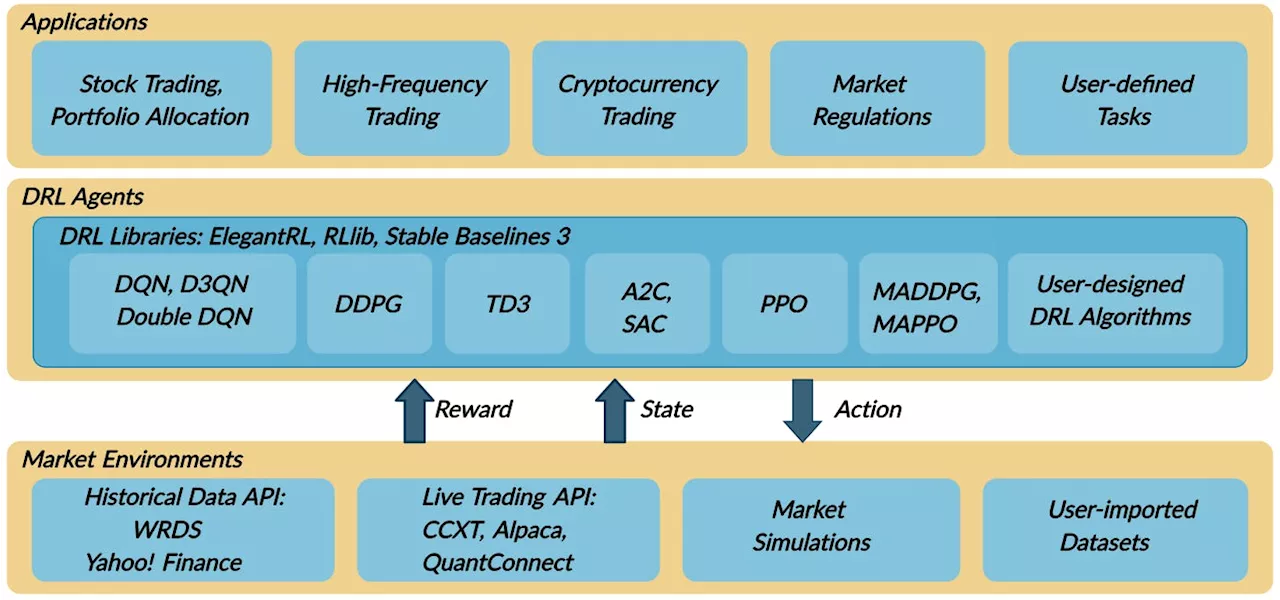
Explore the landscape of open-source DRL libraries for finance, including OpenAI Gym, Google Dopamine, RLlib, and TensorLayer
Authors: Xiao-Yang Liu, Hongyang Yang, Columbia University ; Jiechao Gao, University of Virginia ; Christina Dan Wang , New York University Shanghai . Table of Links Abstract and 1 Introduction 2 Related Works and 2.
1 Deep Reinforcement Learning Algorithms 2.2 Deep Reinforcement Learning Libraries and 2.3 Deep Reinforcement Learning in Finance 3 The Proposed FinRL Framework and 3.1 Overview of FinRL Framework 3.2 Application Layer 3.3 Agent Layer 3.4 Environment Layer 3.5 Training-Testing-Trading Pipeline 4 Hands-on Tutorials and Benchmark Performance and 4.1 Backtesting Module 4.2 Baseline Strategies and Trading Metrics 4.3 Hands-on Tutorials 4.4 Use Case I: Stock Trading 4.5 Use Case II: Portfolio Allocation and 4.6 Use Case III: Cryptocurrencies Trading 5 Ecosystem of FinRL and Conclusions, and References 2.2 Deep Reinforcement Learning Libraries We summarize relevant open-source DRL libraries as follows: OpenAI Gym provides standardized environments for various DRL tasks. OpenAI baselines implements common DRL algorithms, while stable baselines 3 improves with code cleanup and user-friendly examples. Google Dopamine aims for fast prototyping of DRL algorithms. It features good plugability and reusability. RLlib provides highly scalable DRL algorithms. It has modular framework and is well maintained. TensorLayer is designed for researchers to customize neural networks for various applications. TensorLayer is a wrapper of TensorFlow and supports the OpenAI gym-style environments. However, it is not user-friendly 2.3 Deep Reinforcement Learning in Finance Many recent works have applied DRL to quantitative finance. Stock trading is considered as the most challenging task due to its noisy and volatile features, and various DRL based approaches have been applied. Volatility scaling was incorporated in DRL algorithms to trade futures contracts, which considered market volatility in a reward function. News headline sentiments and knowledge graphs, as alternative data, can be combined with the price-volume data as time series to train a DRL trading agent. High frequency trading using DRL is a hot topic. Deep Hedging designed hedging strategies with DRL algorithms that manages the risk of liquid derivatives. It has shown two advantages of DRL in mathematical finance, scalable and model-free. DRL driven strategy would become more efficient as the scale of the portfolio grows. It uses DRL to manage the risk of liquid derivatives, which indicates further extension of our FinRL library into other asset classes and topics in mathematical finance. Cryptocurrencies are rising in the digital financial market, such as Bitcoin , and are considered more volatile than stocks. DRL is also being actively explored in automated trading, portfolio allocation, and market making for cryptocurrencies . This paper is available on arxiv under CC BY 4.0 DEED license. Authors: Xiao-Yang Liu, Hongyang Yang, Columbia University ; Jiechao Gao, University of Virginia ; Christina Dan Wang , New York University Shanghai . Authors: Authors: Xiao-Yang Liu, Hongyang Yang, Columbia University ; Jiechao Gao, University of Virginia ; Christina Dan Wang , New York University Shanghai . Corresponding Author Table of Links Abstract and 1 Introduction Abstract and 1 Introduction 2 Related Works and 2.1 Deep Reinforcement Learning Algorithms 2 Related Works and 2.1 Deep Reinforcement Learning Algorithms 2.2 Deep Reinforcement Learning Libraries and 2.3 Deep Reinforcement Learning in Finance 2.2 Deep Reinforcement Learning Libraries and 2.3 Deep Reinforcement Learning in Finance 3 The Proposed FinRL Framework and 3.1 Overview of FinRL Framework 3 The Proposed FinRL Framework and 3.1 Overview of FinRL Framework 3.2 Application Layer 3.2 Application Layer 3.3 Agent Layer 3.3 Agent Layer 3.4 Environment Layer 3.4 Environment Layer 3.5 Training-Testing-Trading Pipeline 3.5 Training-Testing-Trading Pipeline 4 Hands-on Tutorials and Benchmark Performance and 4.1 Backtesting Module 4 Hands-on Tutorials and Benchmark Performance and 4.1 Backtesting Module 4.2 Baseline Strategies and Trading Metrics 4.2 Baseline Strategies and Trading Metrics 4.3 Hands-on Tutorials 4.3 Hands-on Tutorials 4.4 Use Case I: Stock Trading 4.4 Use Case I: Stock Trading 4.5 Use Case II: Portfolio Allocation and 4.6 Use Case III: Cryptocurrencies Trading 4.5 Use Case II: Portfolio Allocation and 4.6 Use Case III: Cryptocurrencies Trading 5 Ecosystem of FinRL and Conclusions, and References 5 Ecosystem of FinRL and Conclusions, and References 2.2 Deep Reinforcement Learning Libraries We summarize relevant open-source DRL libraries as follows: OpenAI Gym provides standardized environments for various DRL tasks. OpenAI baselines implements common DRL algorithms, while stable baselines 3 improves with code cleanup and user-friendly examples. OpenAI Gym Google Dopamine aims for fast prototyping of DRL algorithms. It features good plugability and reusability. Google Dopamine RLlib provides highly scalable DRL algorithms. It has modular framework and is well maintained. RLlib TensorLayer is designed for researchers to customize neural networks for various applications. TensorLayer is a wrapper of TensorFlow and supports the OpenAI gym-style environments. However, it is not user-friendly TensorLayer 2.3 Deep Reinforcement Learning in Finance Many recent works have applied DRL to quantitative finance. Stock trading is considered as the most challenging task due to its noisy and volatile features, and various DRL based approaches have been applied. Volatility scaling was incorporated in DRL algorithms to trade futures contracts, which considered market volatility in a reward function. News headline sentiments and knowledge graphs, as alternative data, can be combined with the price-volume data as time series to train a DRL trading agent. High frequency trading using DRL is a hot topic. Deep Hedging designed hedging strategies with DRL algorithms that manages the risk of liquid derivatives. It has shown two advantages of DRL in mathematical finance, scalable and model-free. DRL driven strategy would become more efficient as the scale of the portfolio grows. It uses DRL to manage the risk of liquid derivatives, which indicates further extension of our FinRL library into other asset classes and topics in mathematical finance. Cryptocurrencies are rising in the digital financial market, such as Bitcoin , and are considered more volatile than stocks. DRL is also being actively explored in automated trading, portfolio allocation, and market making for cryptocurrencies . This paper is available on arxiv under CC BY 4.0 DEED license. This paper is available on arxiv under CC BY 4.0 DEED license. available on arxiv
United States Latest News, United States Headlines
Similar News:You can also read news stories similar to this one that we have collected from other news sources.
 Deep Lake, a Lakehouse for Deep Learning: Current ChallengesResearchers introduce Deep Lake, an open-source lakehouse for deep learning, optimizing complex data storage and streaming for deep learning frameworks.
Read more »
 Deep Lake, a Lakehouse for Deep Learning: Deep Lake System OverviewResearchers introduce Deep Lake, an open-source lakehouse for deep learning, optimizing complex data storage and streaming for deep learning frameworks.
Read more »
 Deep Lake, a Lakehouse for Deep Learning: Conclusions, Acknowledgement, and ReferencesResearchers introduce Deep Lake, an open-source lakehouse for deep learning, optimizing complex data storage and streaming for deep learning frameworks.
Read more »
 Deep Lake, a Lakehouse for Deep Learning: Performance BenchmarksResearchers introduce Deep Lake, an open-source lakehouse for deep learning, optimizing complex data storage and streaming for deep learning frameworks.
Read more »
 Deep Lake, a Lakehouse for Deep Learning: Machine Learning Use CasesResearchers introduce Deep Lake, an open-source lakehouse for deep learning, optimizing complex data storage and streaming for deep learning frameworks.
Read more »
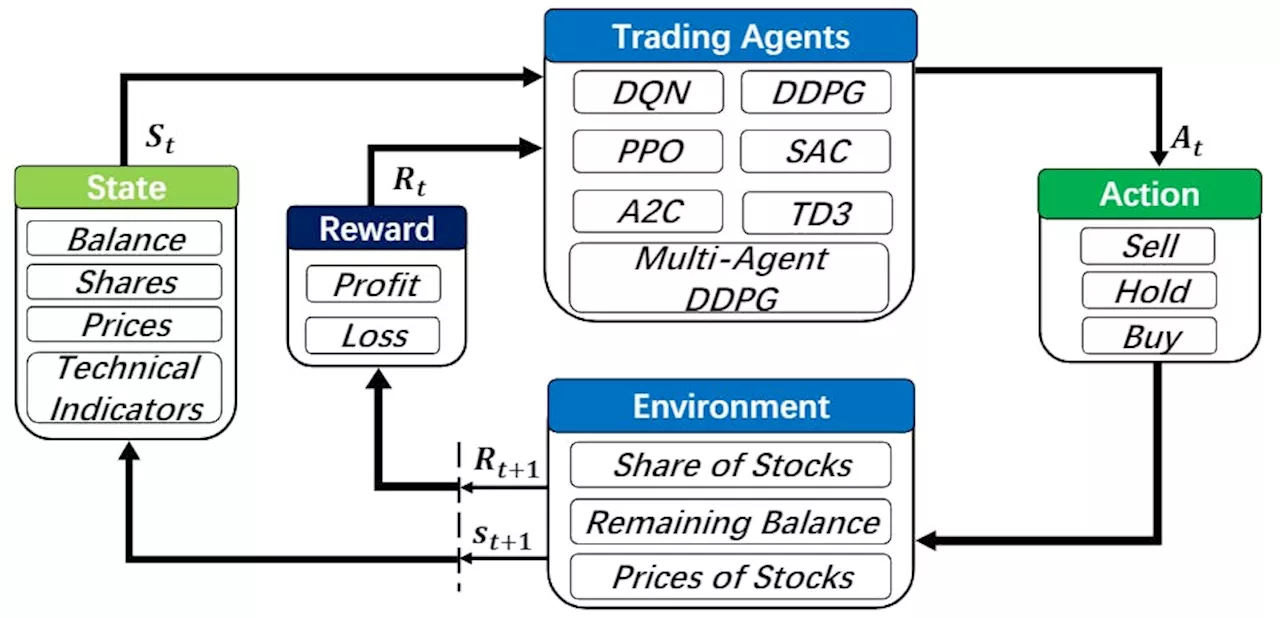 Deep Reinforcement Learning Framework to Automate Trading in Quantitative FinanceFinRL is an open-source framework for quantitative traders, simplifying DRL strategy development with customizable, reproducible, and beginner-friendly tools.
Read more »