Coming soon to college football: Fewer plays, shorter games, and lots of disagreement.
Following the handful of safety-related changes to gameplay itself, such as recent modifications to kickoff rules, the FBS may in the very near future attack health and safety concerns at the source: by cutting down on the number of plays per individual game and across an entire season.
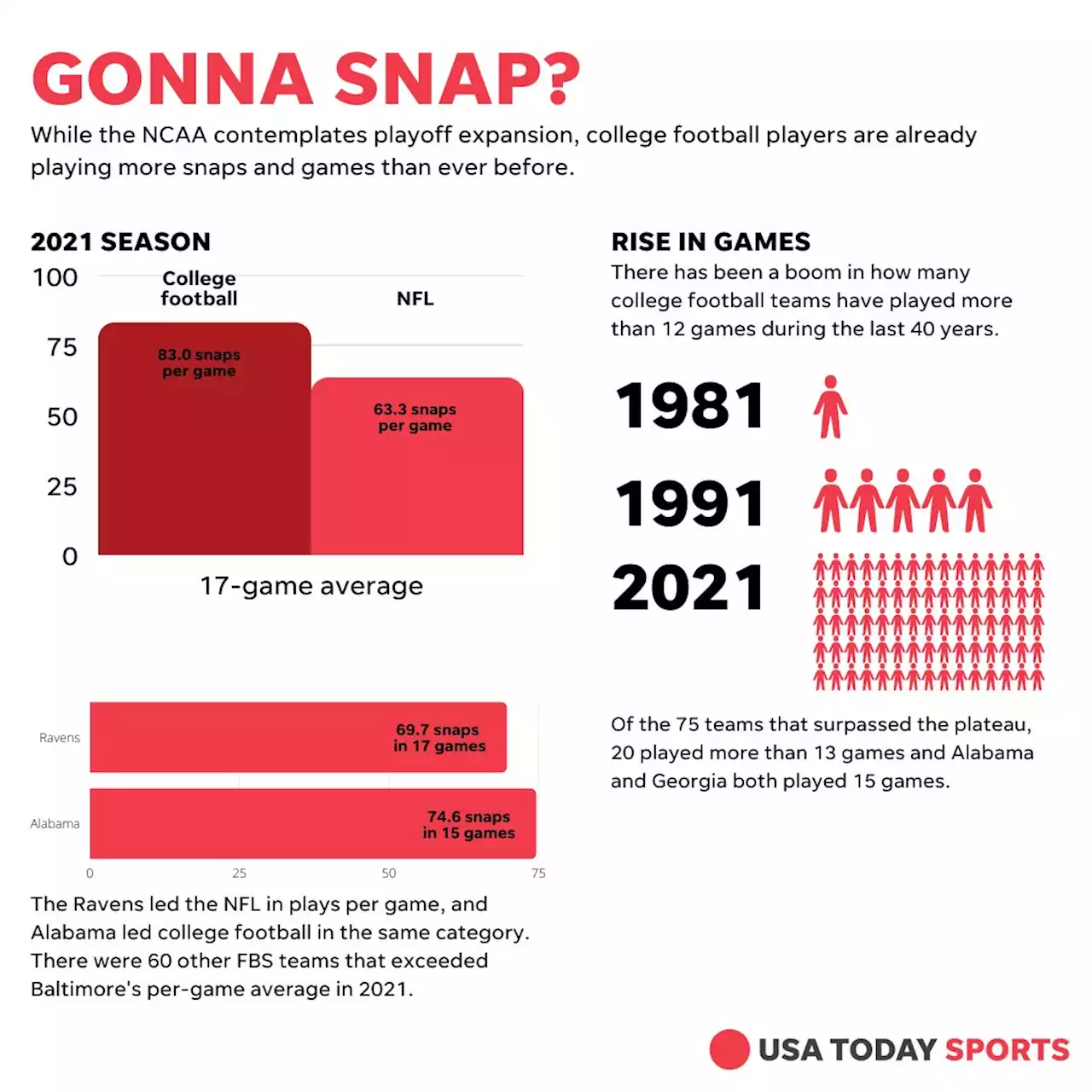
"If you’re going to increase the number of games in a college season, you’ve got to figure out some changes where we can decrease the number of plays," said Arkansas athletics director Hunter Yurachek, a member of the Division I Football Oversight Committee."We don’t need student-athletes, young men out there playing 80, 90, 100 plays a game because of the high-powered offenses in the college game." If adopted, measures related to lowering the number of exposures per game and per season could dramatically alter the way the sport is played on the college level. As of this spring and summer, conferences and various committees are weighing three central issues:► And whether it can be achieved while maintaining the uniqueness that has long separated the college game from the style of play in the NFL. "Everyone is worried about player safety, especially with the number of athletes that everybody has to work with," said Kansas State coach Chris Klieman. Teams in the FBS averaged 71.3 plays per game in 1971 and reached a high of 72 plays per game in 2014, only once in this half-century period of widespread offensive evolution dipping below an average of 67.7. What has changed in this span, however, is the number of games played across a season, and thus the total number of plays each team will face during a given year. During the 2021 season, 75 teams, well above half of the FBS, played more than 12 games; only one team played more than 12 games in 1981 and just five in 1991. The topic has become even more time-sensitive given the strong possibility of additional games coming to the postseason calendar.Texas needs to win games this fall to prove it's the right fit for top 2023 recruit While overly optimistic College Football Playoff expansion talks disintegrated this winter, keeping the current four-team format in place for the next four years, the playoff is expected to grow to an eight- or 12-team bracket in 2026. In the case of a 12-team field, multiple teams could play 16 or even 17 games in a single season. "I think we could’ve expanded the College Football Playoff and then used the next two years to come to a really effective conclusion," said SEC Commissioner Greg Sankey. "Others didn’t see it that way. What I hope we don’t do is lose focus on continuing to think about how we update the game in a healthy way."Even as FBS conferences and administrators struggle to find common ground in the playoff conversation, steps to increase the speed of games and decrease the number of exposures have coalesced around two measures. Running the clock after first downs. College football has long differentiated itself from the NFL by stopping the clock after each first down. Under existing rules,"the game clock is stopped on an official’s signal" with each new set of downs, according to the FBS rulebook, with the clock restarting on the ensuing snap or the referee's signal. "Some things like that will help speed up the game, reduce the number of total plays, and I think that’s better for the student-athletes," Yurachek said. With FBS teams averaging 20.8 first downs per game in 2021, this move could trim minutes off the clock with a commensurate drop in the number of overall snaps. "If you just kept the clock running after first downs, you’d eliminate 8-10 plays," Klieman said. "That would be one way that you could shorten the game a little bit." Running the clock after incomplete passes. While the clock would not continue to run after an incompletion, as it does on a running play, the FBS could adopt a change that would restart the clock before the ensuing snap on the referee's signal.FBS teams averaged 396.1 attempts in 2021, or an average of 31.1 passes per game, and completed 60.9% of those attempts. "Some of these issues in our game are intertwined together," said Steve Shaw, the NCAA national coordinator of officials."Certainly the pace and the tempo in our game is an issue. Can teams substitute, can they not? How does that impact, you know, the player health and safety? So I think as we put this data together, it’s not only just a play count, look at your watch and how long did that game take, but what are the circumstances?" While these suggestions are a topic of conversation across multiple key blocs — including individual Power Five conferences, the Oversight Committee, the NCAA Football Rules Committee and the American Football Coaches Association — the possibility of such drastic changes to the sport have triggered an equally monumental question in response: Are there ways to tweak gameplay while still protecting the unique nature of college football? Compared to the more staid nature of NFL gameplay, college football is a kaleidoscope of quirky and offbeat offensive schemes designed in part to lessen the talent gap between opposing teams. Even as most teams have embraced an up-tempo style, there is variety even among the nation's busiest offenses: Oklahoma State ranked fourth nationally in total plays last season but ran the ball 58.1% of the time; Western Kentucky ranked seventh in offensive snaps but threw the ball on 66.7% of plays. Cutting down on plays per game may not lead to an NFL-like homogeneity in offensive style across the FBS. Still, steps taken to manage the number of overall plays per season could change the way college football is played and possibly signal the end of the sport's ongoing offensive revolution. "The NFL does really well," Sankey said. "They’re averaging about three hours per game. But that game is played in a different manner. You don’t see the type of creativity. I don’t mean that pejoratively. But in offenses, spread, hurry-ups, like you do in college."Efforts to alter longstanding gameplay rules could find another impediment among coaches, with clear lines drawn between those favoring speedy, play-heavy designs and those adhering to a more traditional approach to offense and defense. That makes it unlikely that any rule changes would be palatable to the entire swath of the FBS; instead, any colossal updates to the longstanding model could be embraced and despised in almost equal measure. "What we decide to do is never going to be 100% popular across the country," said Stanford coach and rules committee chair David Shaw. "There is a push-pull, typically between offense and defense, between spread and non-spread, between up-tempo and those that are on the defense trying to defend up-tempo. I don’t think that’s going to change. It hasn’t changed for years." The makeup of teams in the SEC illustrates this push and pull. While the conference has been proactive in evaluating ways to limit exposures, including by contracting external research firms and coordinating conversations with the league's student-athlete advisory committee, gameplay in the SEC includes multiple up-tempo schemes — pass-happy at Mississippi State, balanced at Alabama, more run-focused at Mississippi — in addition to the more conventional styles used by Kentucky, Texas A&M and others. But the league's reinvention from the defense-first mode that defined the FBS in the 2000s and first half of the 2010s has helped the SEC remain an unstoppable juggernaut during the playoff era. If the league is uncomfortable with giving back any edge provided by this combination of cutting-edge schemes and unmatched talent, could the FBS really move forward with sweeping changes to gameplay — even if those changes are made in the vein of improving player health and safety? "What I would encourage is we respect the ability" for different offenses, said Sankey."We want the creativity. I like the creativity between Mike Leach and Lane Kiffin and Josh Heupel, and the traditional approach that’s part of other offenses. Or the middle ground, the ability to do things differently." The conversations afoot this offseason will attempt to thread the needle on the dominant on-field topic of the day. "We love this game," David Shaw said. "The people who play it love playing it. There is an obvious risk element to it. As much as we can make it as safe as possible and as commonsense as possible, that’s what we try to do on the rules committee."
United States Latest News, United States Headlines
Similar News:You can also read news stories similar to this one that we have collected from other news sources.
Cyan Racing's Volvo P1800 Restomod Is Coming Stateside With A $700,000 Sticker | CarscoopsCyan Racing's Volvo P1800 Restomod Is Coming Stateside With A $700,000 Sticker | Carscoops carscoops
Read more »
SSC 'Little Brother' coming with second factorySSC plans to follow up its Tuatara hypercar with a more accessible model due around 2025.
Read more »
4 Nostalgic Grocery Store Favorites Coming Back Soon — Eat This Not ThatThere are some grocery store favorites from years ago we will never forget—fortunately, four are coming back right now.
Read more »
New FCC Rules Are Designed To Stop Robocalls Coming From Other CountriesThe rules target gateway providers that let scammers appear to have a local phone number.
Read more »
‘Willow’ Sequel Series Coming to Disney+ This NovemberThe upcoming 'Willow' sequel series on Disney+ has officially set a release date for November.
Read more »
PS5 Pro and new Xbox Series X coming in 2023, according to TCLTCL mentioned the PS5 Pro and new Xbox Series X/S release window in a TV product presentation - here’s what you need to know.
Read more »