
The most important stories for you to know today
U.S. Immigration and Customs Enforcement agents arrest an immigrant considered a threat to public safety and national security during an early morning raid in Compton on June 6, 2022.One of President Trump’s first executive orders threatened to withhold federal funding from so-called sanctuary jurisdictions.
California is one of them.It’s not clear yet what kind of federal funds the Trump administration would withhold. But, for a state of 39 million people that relies heavily on federal dollars for its public programs and currently for its wildfire recovery, withholding money could be a crippling blow.During the Biden administration, the federal government had in place a “sensitive areas” order, which discouraged immigration agents from making arrests in places like schools, hospitals, churches and courthouses. Last week, the Trump administration rescinded that order.Back in the Oval Office, President Donald Trump is once again trying to break a policy California Democrats adopted during his first term to protect certain undocumented immigrants from being deported. One of his first executive orders targets the state’s so-called sanctuary law, which generally limits how local cops interact with federal immigration officers. Trump’sIt’s not clear yet what kind of federal funds the Trump administration would withhold. But, for a state of 39 million people that relies heavily on federal dollars for its public programs and currently for its wildfire recovery, withholding money could be a crippling blow.So what does the state’s sanctuary law do exactly and what does it mean for Trump’s mass deportation plans?signed into law Senate Bill 54, the California Values Act, commonly referred to as the state’s sanctuary law. That law bars state and local police from investigating, interrogating, or arresting people for immigration enforcement purposes, and limits — but does not entirely prohibit — police cooperation with federal immigration officials.that the point of the law was to make clear that the feds cannot enlist local police “as a cog in the Trump deportation machine.” The “sanctuary” movement goes back to the 1980s when Central American refugees fled civil war and immigrated to the U.S. When they were denied asylum, they sought protection from deportation in churches and other places of worship. Today the sanctuary law does not actually refer to a place or territory where immigrants can seek protection. Living in California alone does not shield someone from deportation. Instead, the law clarifies what state and local law enforcement in California can and cannot do with regard to immigration. For example, the law says that local police cannot detain or keep someone in custody more than 48 hours past their release date just for immigration officials to pick them up. The law does not restrict what the federal government can do in the state. To be clear, that means U.S Immigration Customs and Enforcement can still arrest and deport undocumented people living in California and other sanctuary jurisdictions. “The federal government has a lane that they are entitled to move in, they can enforce immigration law,” California Attorney General Rob Bonta said last week during a press conference in San Diego. But “They can’t conscript or force the city or the county or the state law enforcement entities to do their job for them.”have repeatedly argued that sanctuary laws shield dangerous criminals. They have at times pointed to specific crimes committed by undocumented immigrants to argue the sanctuary law puts the greater public at risk. In 2019, for example, Trump pointed to the slaying of aBut that’s not the whole story. The law says police can tell immigration authorities about an inmate’s upcoming release if that person has been convicted ofto immigration authorities. At the same time, ICE doesn’t always show up when someone is released from jail or prison. For example, ICE picked up about 80% of undocumented immigrants released from state prisons between 2017 and 2020, according to a 2022 “It is an absurdity to be talking about SB 54 as preventing bad, non-citizens with serious criminal convictions from being turned over to , it doesn’t do that,” said Niels Frenzen, a professor at USC’s Gould School of Law and co-director of the school’s immigration clinic. “But those facts are just not part of the political debate.” Immigrants who are protected by the sanctuary state law are usually those who are arrested for less serious offenses, such as traffic violations and driving without a license or insurance, Frenzen said.Some immigration attorneys, however, have pointed out that the state law seemed to have little impact on ICE’s ability to do its job.said that in 2017 ICE apprehended 20,201 unlawfully present people in California, which represented about 14% of all ICE arrests made that year. ICE was on track to exceed that number in the following year. In the first two months of 2018 after the sanctuary law took effect, it arrested 8,588 people in California, or about 14% of all arrests nationwide, according to a filing in the lawsuit by Trump’s Justice Department.In a separate fight, California sued the Trump administration for its policy to withhold federal law enforcement grants from jurisdictions with sanctuary policies. A federal judge sided with California.Critics of the law have long claimed that the sanctuary state law harms public safety. The Hoover Institution, a conservative think tank at Stanford, for example,, noting that a spike in fentanyl-related deaths started happening around 2018, soon after the sanctuary policy went into effect. Whether causation or coincidence, there isn’t much in the way of official research that proves this. To prove such a claim, one would have to isolate the sanctuary state law’s specific impact on crime, researchers say.by researchers at the University of California, Irvine examined the state’s 2018 violent and property crime rates and compared them to estimated crime rates had Gov. Brown not signed the sanctuary policy. The study found that the law did not have a significant impact on either violent crime or property crime. Charis Kubrin, who authored the study, said the takeaway of her research was that changing the state’s sanctuary status is not likely to result in major reductions in crime. “Getting rid of SB 54, for example, is not going to make crime go down because it didn’t cause crime to go up in the first place,” Kubrin said.by researchers at Stanford and Princeton looked at sanctuary policies across the country and found that these measures reduce the overall number of deportations by one-third, but they did not reduce the number of deportations on people with violent criminal convictions.During the Biden administration, the federal government had in place a “sensitive areas” order, which discouraged immigration agents from making arrests in places like schools, hospitals, churches and courthouses. Last week, the Trump administration rescinded that order. “When ICE engages in civil immigration enforcement actions in or near courthouses it can reduce safety risks to the public,” reads a Jan. 21 memo to staff from ICE Acting Director Caleb Vitello. The sanctuary state law asks officials at the same places to adopt policies to limit public participation with immigration enforcement, such as requesting a warrant from ICE agents before they attempt to arrest anyone. That could create a conflict for local officials if the immigration crackdown in the new administration hits their venue, said Alvaro Huerta, director of litigation and advocacy at Immigrant Defenders Law Center. Given Trump’s recent rule reversal, Huerta said, “the federal government may attempt some enforcement in those spaces, but the state government is asking those spaces to require warrants.”
United States Latest News, United States Headlines
Similar News:You can also read news stories similar to this one that we have collected from other news sources.
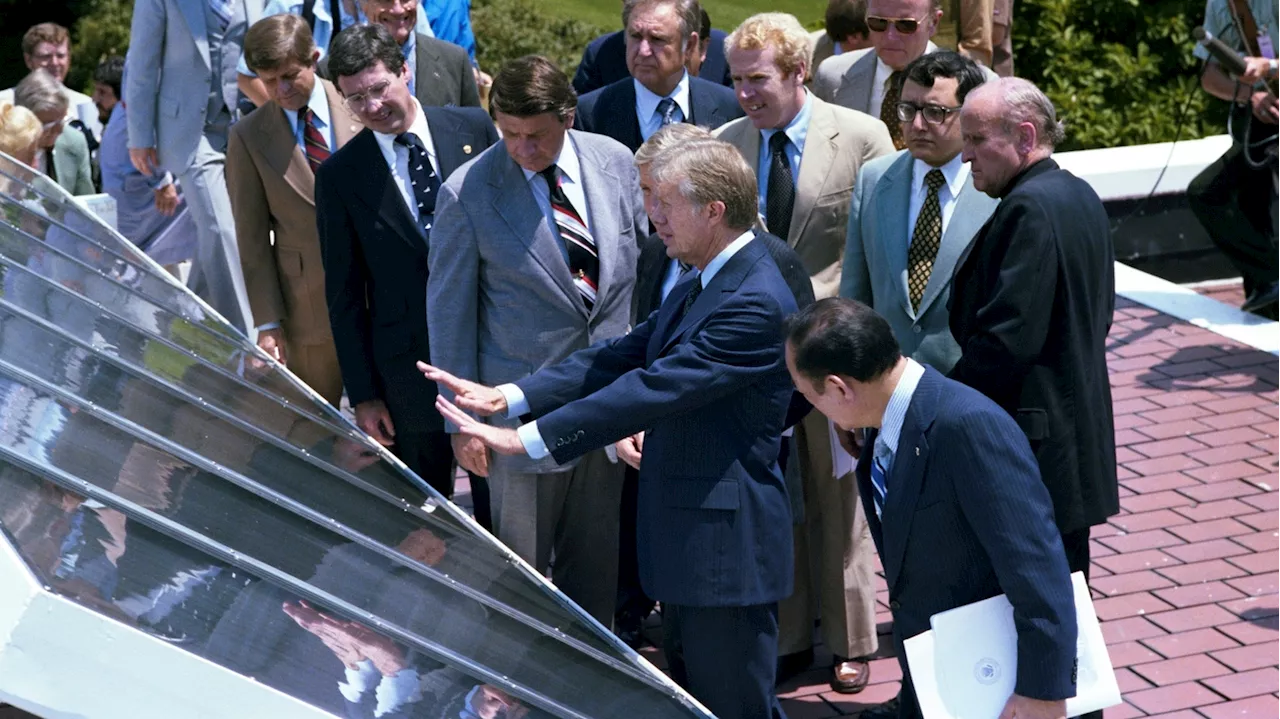 Jimmy Carter's environmental legacy set the foundation for today's climate actionFormer President Jimmy Carter's work on energy efficiency and renewable energy were criticized, but it laid the groundwork for the country to address climate change now.
Read more »
 Today in History: December 30, Saddam Hussein executedFormer Iraqi president Saddam Hussein was executed by hanging after being convicted of crimes against humanity by the Iraqi High Tribunal
Read more »
 Silver price today: broadly unchanged on December 30Silver prices (XAG/USD) broadly unchanged on Monday, according to FXStreet data.
Read more »
 NYT Crossword Answers TodayGet the solutions to today's New York Times crossword puzzle, complete with clues for across answers.
Read more »
 Newsweek's Hints to Solve Today's Connections PuzzleEnd 2024 on a winning note with Newsweek's handy hints for today's Connections puzzle. This popular brainteaser from The New York Times challenges players to find connections between words.
Read more »
 Today in Pa. Podcast Covers Latest Pennsylvania NewsThe Today in Pa. podcast, hosted by Claudia Dimuro, covers the most important and interesting stories happening in Pennsylvania.
Read more »