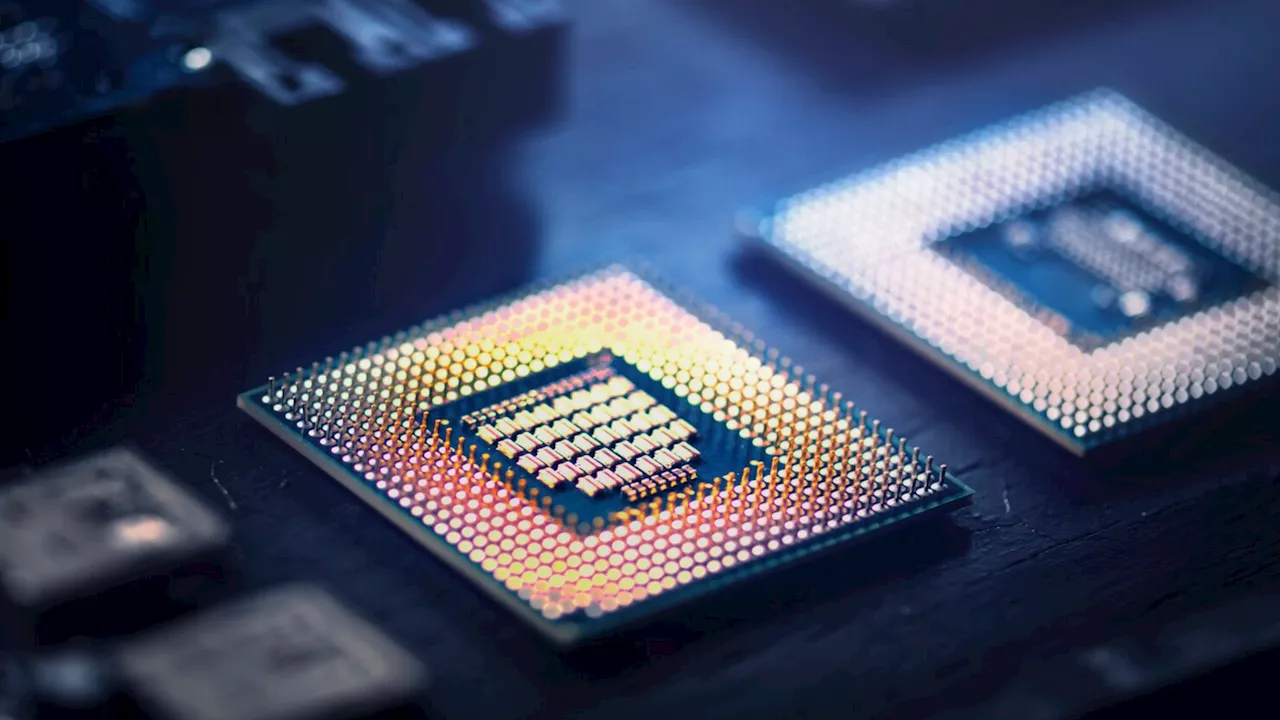
A computing chip, developed by a team from KAIST, mimics the way brain processes information and is ready for uses on various smart devices.
A team of researchers from Korea Advanced Institute of Science & Technology in South Korea has developed a memristor-based integrated chip that mimics the way information is processed in the brain.The team led by professors Shinhyun Choi and Young-Gyu Yoon’s has come up a next-gen neuromorphic chip, an ultra-small semiconductor that learns and corrects errors independently.
The study was published in Nature Electronics. The chip is now ready for deployment in various devices, such as smart security cameras that instantly detect suspicious activity without relying on cloud servers, and medical devices that analyze health data real time.Solving challenges in neuromorphic devicesThis computing chip stands out for its ability to learn and correct errors caused by non-ideal characteristics, a challenge in existing neuromorphic devices. For instance, when processing video streams, it can automatically separate moving objects from the background and improve its performance over time.This self-learning chip has demonstrated its capabilities by achieving accuracy comparable to ideal computer simulations in real-time image processing. The research team’s key accomplishment lies in creating a system that is not only reliable but also practical, surpassing the development of individual brain-like components.Central to this innovation is a next-generation semiconductor device called a memristor. Its variable resistance properties mimic the role of synapses in neural networks, enabling simultaneous data storage and computation, much like how our brain cells function.The memristor precisely controls resistance changes, creating an efficient system that removes the need for complex compensation through self-learning. This study is important because it shows the commercial potential of a next-gen neuromorphic system for real-time learning and inference.AI tasks processed locally for improved speed Memristor-based platforms could enable compact and energy-efficient AI edge-computing systems due to their ability to perform parallel computation in the analog domain. However, memristor array-based systems face challenges in implementing real-time AI algorithms with on-device learning due to reliability issues like low yield, poor uniformity, and endurance problems.Now, this technology aims to transform how AI is integrated into everyday devices, enabling AI tasks to be processed locally. This reduces reliance on remote cloud servers, making devices faster, more secure, and energy-efficient, the study noted.“We use interfacial-type titanium oxide memristors with a gradual oxygen distribution that exhibit high reliability, high linearity, forming-free attribute and self-rectification,” the scientists stated in their paper, adding that the platform can run AI algorithms in the analog domain through self-calibration, without the need for compensation or pre-training.According to KAIST researchers Hakcheon Jeong and Seungjae Han, who led the development of this technology, the system functions like a smart workspace where everything is easily accessible, eliminating the need to go back and forth between desks and file cabinets.As they further explain, this system mirrors how the brain processes information, where everything is efficiently handled at once in a single location.
AI Algorithms Energy Efficiency Inventions And Machines KAIST Microchip Sustainability
United States Latest News, United States Headlines
Similar News:You can also read news stories similar to this one that we have collected from other news sources.
 Accustomed to heartbreak, can UCLA's Mick Cronin get his Gonzaga breakthrough?Mick Cronin is 0-4 against Gonzaga as UCLA coach, a mark he hopes to start reversing Saturday when the Bruins take on the Bulldogs at the Intuit Dome.
Read more »
 KAIST Researchers Transform Colon Cancer Cells into Normal-Like CellsA groundbreaking study by KAIST researchers offers a new approach to cancer treatment by transforming colon cancer cells into normal-like cells without destroying them.
Read more »
 JonBenét Ramsey's Father Holds Out Hope for DNA Breakthrough in Cold CaseJohn Ramsey, the father of JonBenét Ramsey, expresses optimism that a recent DNA breakthrough could finally lead to the resolution of his daughter's 1996 murder. He plans to meet with the new chief of Boulder Police to discuss utilizing advanced forensic techniques and FBI resources to identify the killer.
Read more »
 Crossing the Uncanny Valley: Breakthrough in technology for lifelike facial expressions in androidsEven highly realistic androids can cause unease when their facial expressions lack emotional consistency. Traditionally, a 'patchwork method' has been used for facial movements, but it comes with practical limitations.
Read more »
 U. biochemist's research on HIV contributes to Science's 'Breakthrough of the Year'The lab of a University of Utah biochemist laid the foundation for the development of a highly effective, long-lasting drug against HIV and was recently awarded for the effort.
Read more »
 Unlocking the Secrets of Prime Numbers: A Collaborative BreakthroughMathematicians Ben Green and Mehtaab Sawhney recently proved the existence of infinitely many primes of a specific form, showcasing the power of collaboration and cross-disciplinary tools in solving complex mathematical problems.
Read more »