
While gravity is the dominant force in our Solar System, a new paper explores other forces that influence the motion of smaller celestial bodies. These include recoil from cometary ice sublimation, radiation pressure from the Sun, and relativistic effects.
Ever since Isaac Newton famously talked about gravity, its dominance as a force in our Solar System has been well known. It’s responsible for the orbits of the planets and their satellites but there are other forces that have shaped our planetary neighbourhood.
A new paper has been released where an astronomer discusses how recoiling ice from comets can push them around and how the radiation pressure from the Sun drives material outwards. There are also relativistic effects too that can cause particles to spiral inward toward the Sun. Gravity is the force that governs the structure and motion of the solar system, keeping celestial bodies together in a cosmic dance. The Sun, with its immense mass, generates the strongest gravitational pull, anchoring planets, asteroids, comets, and other objects in orbit around it. Each planet’s orbit results from the balance between its velocity and the Sun’s gravitational force, creating elliptical paths described by Kepler’s laws of motion. Similarly, moons remain in orbit around their host planets due to the gravitational forces exerted by their parent planet. Gravity not only maintains the stability of these orbits but also influences phenomena like tides on Earth, caused by the Moon’s gravitational pull. View of Moon limb with Earth on the horizon,Mare Smythii Region. Earth rise. This image was taken before separation of the LM and the Command Module during Apollo 11 Mission. Original film magazine was labeled V. Film Type: S0-368 Color taken with a 250mm lens. Approximate photo scale 1:1,300,000. Principal Point Latitude was 3 North by Longitude 85 East. Foward overlap is 90%. Sun angle is High. Approximate Tilt minimum is 65 degrees,maximum is 69. Tilt direction is West . In the paper authored by David Jewitt from the University of California he explores other forces that shape our Solar System. Gravity certainly describes the motion of planetary mass bodies but there are other forces that impart forces upon smaller bodies that are susceptible to their effects. These forces include, but are not limited to recoil torque from mass loss, radiation pressure and more. The aim of the paper is to offer a simple yet informative overview of the various non-gravitational forces at play in the Solar System. There are references to relevant applications from existing papers and publications, presenting them in a way that is accessible to non-specialists. An important point to note is that the paper assumes that all orbits are circular, whereas real bodies are not perfectly spherical and orbits are not perfectly circular. The author asserts that these approximations ensure that rough estimates of the magnitudes of forces can still be achieved. Among the non-gravitational forces considered in the paper, the largest by far is the recoil produced by the sublimation of ice on comets and asteroids. The heat from the Sun causes the ice to immediately turn into a gas rather than melt to a liquid, this is the sublimation process. Like a bullet leaving a gun however, and in accordance with Newton’s laws, when the ice sublimates, the escaping volatile gasses will carry momentum and exert a recoil force on the body. The process of sublimation depends largely on temperature and acts in the anti-solar direction. Related to the appearance of comets is another force, radiation pressure, that shapes their distinctive tails. It’s the force exerted by light when photons transfer momentum to an object such as cometary dust and gas pushing them away. The pressure depends on the intensity of the radiation and the object’s reflectivity, with more reflective objects experiencing greater force. Though small, radiation pressure can shape comet tails and gradually alter the orbits of small bodies in the solar system. The Sun releases a steady stream of charged particles called the Solar Wind. When it strikes unprotected surfaces like asteroids or the Moon, it can change the chemistry and even create water molecules. Image Credit: NASA’s Goddard Space Flight Center/Mary Pat Hrybyk-Keith
GRAVITY COMETS RADIATION PRESSURE SOLAR WIND ASTEROIDS
United States Latest News, United States Headlines
Similar News:You can also read news stories similar to this one that we have collected from other news sources.
 Solar Cycle 25: Peeking into the Future of Solar ActivityThis article delves into the current state of Solar Cycle 25, highlighting its heightened activity and the implications for future solar events. It explores recent notable solar events like the 2024 total solar eclipse and geomagnetic storms, emphasizing the ongoing increase in solar activity. While the precise peak of Solar Cycle 25 remains uncertain, it's confirmed that its activity surpasses that of the previous cycle.
Read more »
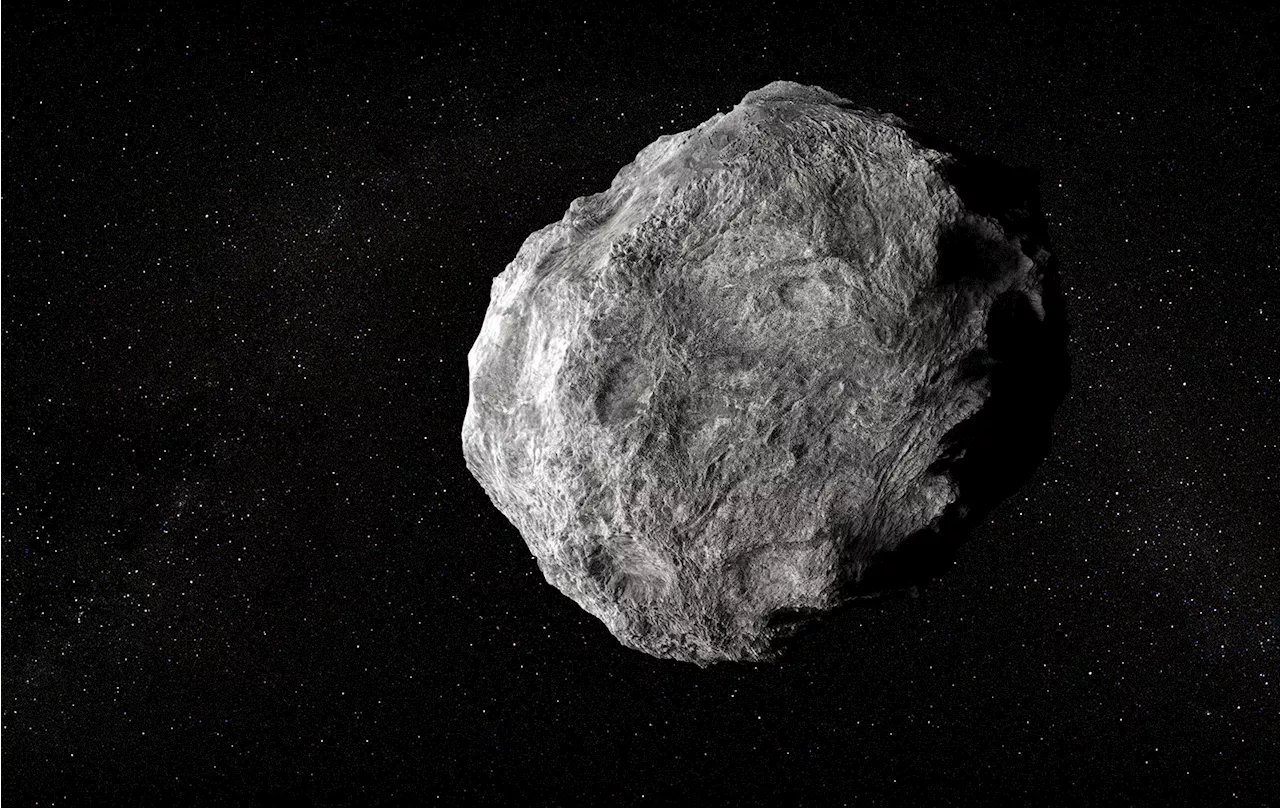 Asteroid-Comet Hybrid Chiron Holds Clues to Solar System's BirthObservations from the James Webb Space Telescope reveal unique ice and gas composition on Chiron, a centaur orbiting between Neptune and Jupiter. This unusual mixture could shed light on the early stages of our solar system's formation.
Read more »
 Anker's Solix Solar Beach Umbrella harnesses Perovskite Solar TechAnker's new Solix Solar Beach Umbrella features a perovskite solar cell technology that promises higher efficiency and lower costs compared to traditional silicon-based cells. The umbrella can generate up to 100W of power, enough to keep Anker's Solix EverFrost 2 Electric Cooler running indefinitely in sunny conditions.
Read more »
 Jackery’s Solar Roof announced alongside new solar generator at CES 2025Jackery’s Solar Roof features curved tiles in terra-cotta red or black with a 25 percent conversion efficiency, while its DC-DC car charger outputs 600W.
Read more »
 Jackery Unveils Solar Roof Tiles, New Solar Generators at CES 2025Jackery is showcasing its latest innovations in home energy solutions and portable power at CES 2025.
Read more »
 San Francisco Solar Company Aurora Solar Lays Off 58 WorkersAurora Solar, a San Francisco-based solar energy software company, has laid off 58 employees, marking the second round of job cuts in a year. The company cited 'ongoing macroeconomic challenges and continued uncertainty in the solar industry' as reasons for the layoffs. Aurora plans to refocus its business in response to the current market conditions.
Read more »