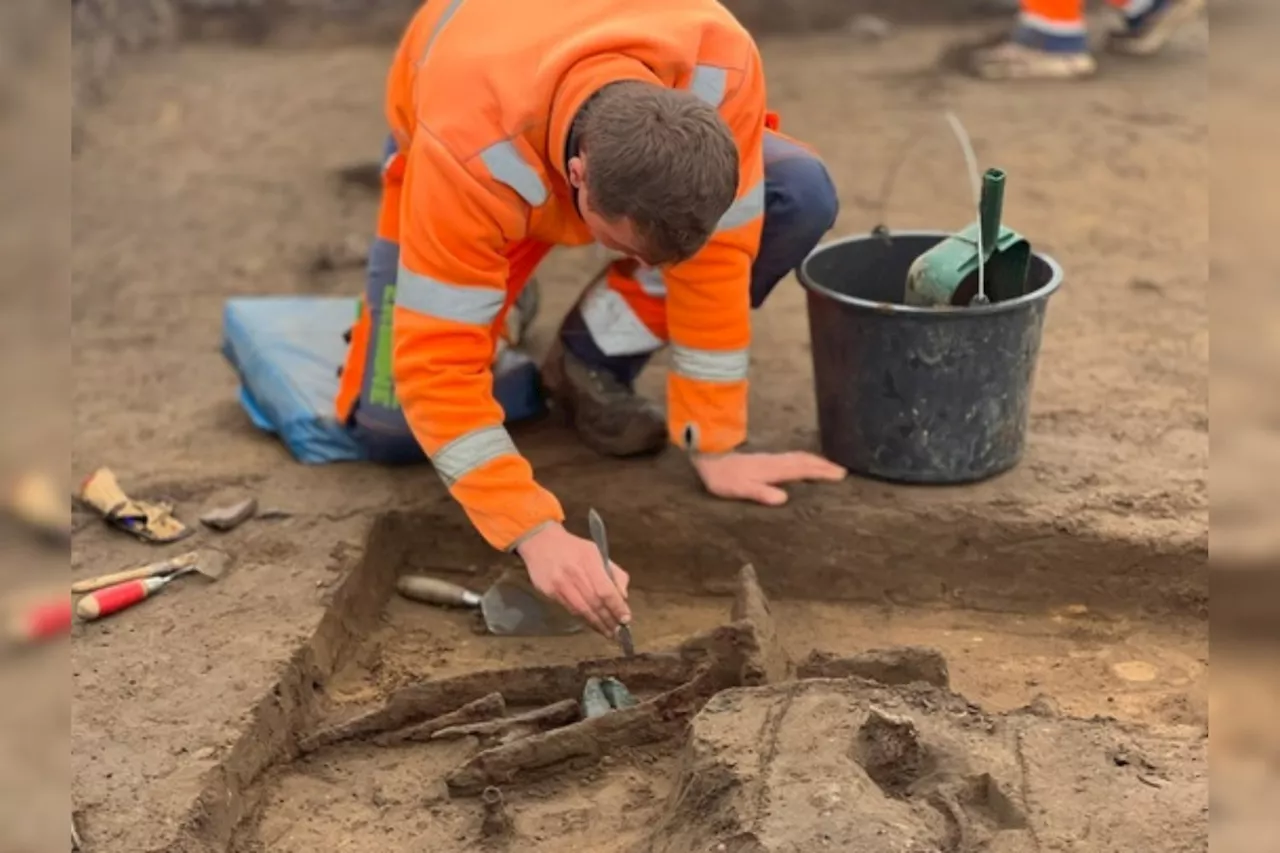
The near-2,000-year-old cache included swords and chainmail, and offers a unique window into the Nordic community that lived there.
A team of archaeologists uncovered a trove of weapons, armor, and other goods in Denmark, in advance of a motorway being built on the site. The deposit is a weapon sacrifice—literally, the weapons were the things sacrificed.
Over 1,500 years ago, an Iron Age community deposited over 100 lances, spears, swords, knives, arrowheads, and more across two houses on the site. Taken together, the deposit is a compelling look into the social and military wheelings and dealings of the group that inhabited the region. Based on the way the items were deposited, the archaeological team concluded that the site was not a weapons workshop or a barracks—settings where piles of weapons would not be out of place. “From the very first surveys, we knew this was going to be extraordinary, but the excavation has exceeded all our expectations,” said Elias Witte Thomasen, an archaeologist at The Vejle Museums and leader of the excavation, in a museums. “The sheer number of weapons is astonishing, but what fascinates me most is the glimpse they provide into the societal structure and daily life of the Iron Age. We suddenly feel very close to the people who lived here 1,500 years ago.” The exact count of the metal objects found at the site is as follows: 119 lances and spears, eight swords, five knives, three arrowheads, one axe, one set of chainmail armor, fragments of at least two oath rings and a bugle, a bridle, and some yet-to-be identified objects. The rings were bracteates: bronze medallions which would be worn around the neck and often expressed the wearers’ political or military allegiance. The bracteates were etched with a design reminiscent of the chainmail found at the site. According to the release, the chainmail is the first discovered on a settlement in southern Scandinavia, rather than in a burial or other deposit. The team also recovered ceramics and flint objects; by their reckoning, the site was occupied for millennia. By the early 400s, the settlement held significant social and economic influence in the area, according to the museums release, allowing it to send out military campaigns to the surrounding area. The team is not sure whether the weaponry belonged to the locals who buried it or was booty recovered from a defeated enemy, though further excavations and analysis of the weapon trove may provide answers. War booty was common in central Europe during the first few centuries CE. According to the, 20 Danish bogs contained Iron Age weaponry with “traces of ritual destruction.” Those weapons may have been offerings to the gods. In the recent site’s case, the community could have used the weapons, but instead chose to hide them in a posthole. In one of the houses, the weaponry was deposited during the house’s deconstruction. The team deduced that because the weapons were placed in a hole left by a post that held up the structure’s roof. The hole was then backfilled—so it was not the most convenient place to store a sword you want easy access to.in a cellar that belonged to Stone Age people who inhabited the site about 5,000 years ago. In October, a team with Denmark’s Museum OdenseOldest Gun Found in the U.S. Tells the Story of a Forgotten BattleFour clay cylinders inscribed with what might be the oldest known evidence of alphabetic writing are 500 years older than other early alphabets, according to new research.The etching, discovered at a Paleolithic campsite, may be the only known evidence hinting at how our ancestors fished over 150 centuries ago.The Arab Muslim victory at the Battle of al-Qadisiyyah paved the way for the Islamic conquest of Mesopotamia and Persia.Human HistoryThe famous conqueror’s burial location remains a mystery, but new research claims that material found in one of the iconic Royal Tombs in Greece may have belonged to him.Upcoming Proba-3 Mission Will Create Artificial Solar Eclipses to Study the Sun12/2/2024, 3:55 pm
United States Latest News, United States Headlines
Similar News:You can also read news stories similar to this one that we have collected from other news sources.
 Irish archaeologists discover 2,000-year-old fig of Roman originToday's Video Headlines: 11/19/24
Read more »
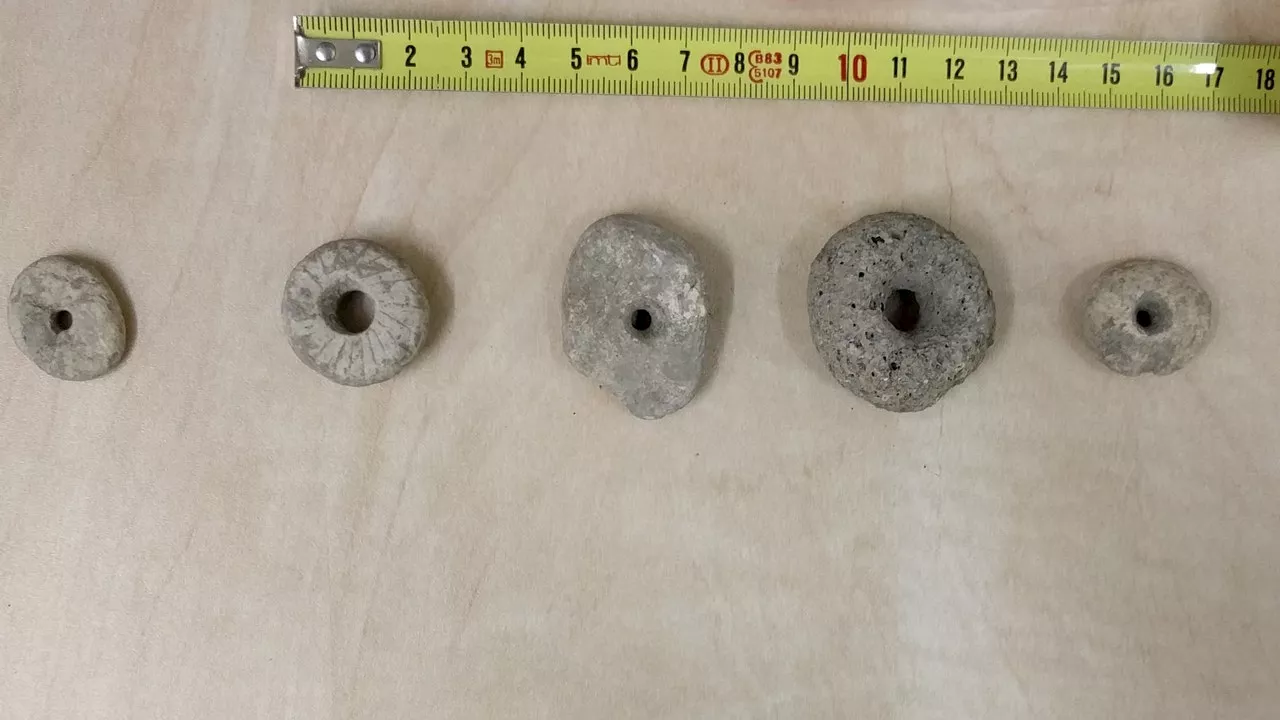 Archaeologists discover 12,000-year-old pebbles that could provide new insights about the wheelResearchers gave a detailed look into perforated stones collected out of excavations in Israel, and came to the conclusion that they could have served as spindle whorls.
Read more »
 Archaeologists discover 4,000-year-old canals used to fish by predecessors of ancient MayaUsing drones and Google Earth imagery, archaeologists have discovered a 4,000-year-old network of earthen canals in what’s now Belize. The research published Friday in Science Advances shows that long before the ancient Maya built temples, their predecessors were already altering the landscape of Central America’s Yucatan peninsula.
Read more »
 Archaeologists discover 4,000-year-old canals used to fish by predecessors of ancient MayaUsing drones and Google Earth imagery, archaeologists have discovered a 4,000-year-old network of earthen canals in what’s now Belize.
Read more »
 Archaeologists discover 4,000-year-old canals used to fish by predecessors of ancient MayaUsing drones and Google Earth imagery, archaeologists have discovered a 4,000-year-old network of earthen canals in what’s now Belize.
Read more »
 Archaeologists discover 4,000-year-old canals used to fish by predecessors of ancient MayaUsing drones and Google Earth imagery, archaeologists have discovered a 4,000-year-old network of earthen canals in what’s now Belize
Read more »