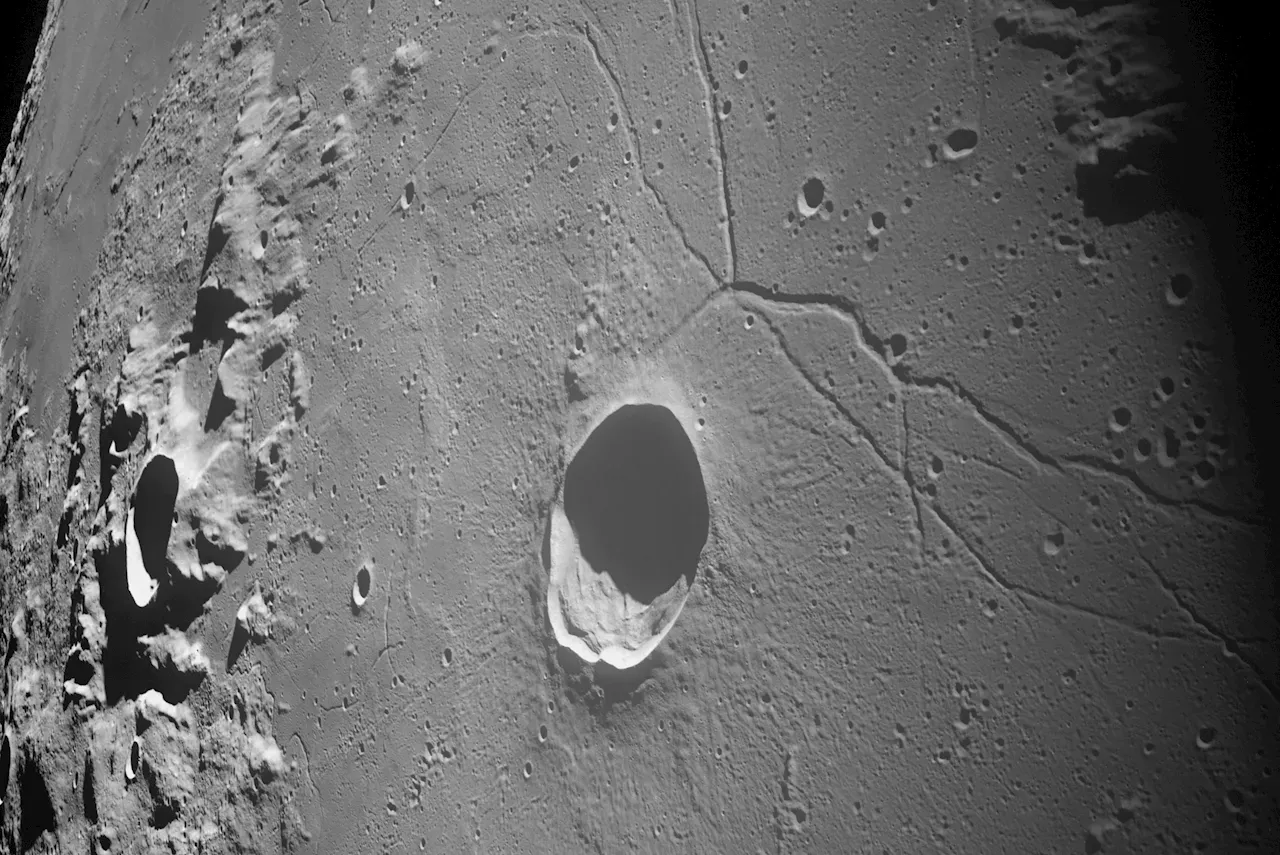
The Apollo 10 mission encompassed all aspects of an actual crewed lunar landing, except the landing. It was the first flight of a complete, crewed Apollo
The Apollo 10 mission encompassed all aspects of an actual crewed lunar landing, except the landing. It was the first flight of a complete, crewed Apollo spacecraft to operate around the Moon. Objectives included a scheduled eight-hour lunar orbit of the separated lunar module, or LM, and descent to about nine miles off the moon’s surface before ascending for rendezvous and docking with the command and service module, or CSM, in about a 70-mile circular lunar orbit.
Pertinent data to be gathered in this landing rehearsal dealt with the lunar potential, or gravitational effect, to refine the Earth-based crewed spaceflight network tracking techniques, and to check out LM programmed trajectories and radar, and lunar flight control systems. Twelve television transmissions to Earth were planned. All mission objectives were achieved. Emblem of the Apollo 10 lunar orbit mission. The prime crew of Apollo 10 is astronauts Thomas P. Stafford, commander; John W. Young, command module pilot; and Eugene A. Cernan, lunar module pilot.Apollo 10 launched from Cape Kennedy on May 18, 1969, into a nominal 115-mile circular Earth-parking orbit at an inclination of 32.5 degrees. One-and-a-half orbits later, translunar injection occurred. The S-IVB fired to increase velocity from 25,593 to 36,651 feet per second on a free-return trajectory. Twenty-five minutes later, the CSM separated for transposition and docking with the LM, similar to the maneuver performed on Apollo 9. The orbital vehicle was comprised of the S-IVB stage, and its payload of the CSM, the LM and spacecraft-lunar module adapter, or SLA, shroud. The Apollo 10 crew members were Commander Thomas Stafford, Command Module Pilot John Young and Lunar Module Pilot Eugene Cernan. The first live color TV transmissions to Earth began three hours after launch when Apollo 10 was 3,570 miles from Earth and concluded when the spacecraft was 9,428 miles away. The transmission showed the docking process and the interior of the CSM. About four hours after launch, Apollo 10 separated from the S-IVB sage, which was followed by another telecast from 14,625 miles out. A third TV transmission of pictures of Earth was made from 24,183 miles out, and a fourth telecast of the Earth was made from 140,000 miles. The launch trajectory had been so satisfactory that only one of four midcourse corrections was needed. This was accomplished 26.5 hours into the flight. About 76 hours into the mission, lunar-orbit insertion occurred with the firing of the service propulsion system, or SPS. A second firing of the engine 4.5 hours later circularized the lunar orbit of Apollo 10 at approximately 69 miles, which was followed by the first color TV pictures to Earth of the moon’s surface. Stafford and Cernan entered the LM and prepared for the undocking maneuver that occurred on the 12th revolution, a little more than 98 hours into the flight. At about 100 hours, on May 22, the vehicles separated and briefly flew a station-keeping lunar orbit of 66.7 by 71.5 miles. To achieve a simulation of the future Apollo 11 landing, the LM descent engine fired for 27.4 seconds, with 10 percent thrust for the first 15 seconds and 40 percent thrust for the rest. This brought the LM to a new orbit of 9.7 by 70.5 miles. The LM flew over Landing Site 2 in the Sea of Tranquility. During this run, the LM landing radar was tested for altitude functioning, providing both “high gate” and “low gate” data. Following a 7.5-second firing of the LM reaction control system, or RCS, thrusters, the descent engine fired in two bursts for 40.1 seconds – at 10 percent and at full throttle – placing the LM into an orbit of 13.7 by 219 miles. On the 14th revolution, it reached a pericynthion of 12.7 miles and was “staged.” The descent stage jettisoned on a second attempt and an uncontrollable gyration of the ascent stage occurred. It was later attributed to an error in a flight-plan checklist, causing an incorrect switch position. The ascent engine fired for 15 seconds, lowering the LM apocythion to 53.8 miles, 230 miles behind and below the CSM. The RCS thrusters fired for 27.3 seconds when the LM was 16.9 miles below the CSM and 170.4 miles behind, yielding an orbit of 54.5 by 48.1 miles. To prepare for the terminal phase of rendezvous, the RCS fired again, resulting in an orbit of 17.2 by 81.7 miles. Stafford sighted the CSM’s running lights at about 48 miles. The 15-second terminal phase initiation firing reduced velocity as the LM entered an intercept trajectory and the two vehicles achieved station-keeping of the 16th lunar revolution. With Young in the CSM taking on an active rendezvous role, the vehicles were re-docked on May 23, slightly more than 106 hours into the mission. The LM ascent stage jettisoned and its engine fired to depletion. The rest of the time in lunar orbit was spent on landmark tracking and photography. On the 31st orbit, the SPS restarted. Apollo 10 was on the back side of the moon when it was injected into a trans-Earth trajectory. After a midcourse correction, and command and service module separation, Apollo 10 re-entered Earth’s atmosphere May 26. The module splashed down 165 degrees west, and 5 degrees, 8 minutes south in the Pacific Ocean. It’s landing was within television range of its primary recovery ship, the USS Princeton. Apollo 10 completed a flight of 192 hours, three minutes, 23 seconds – one minute, 24 seconds longer than planned. The Apollo 10 S-IVB third stage and LM ascent stage went into solar orbits. The LM descent stage went into a selenocentric orbit.L. Gordon Cooper Jr., Commander
United States Latest News, United States Headlines
Similar News:You can also read news stories similar to this one that we have collected from other news sources.
 A Cultural Mission visits with the Mission’s MeklitA creative force in the Mission since her early years at the Red Poppy Art House, Meklit will be at Brava to celebrate a new release.
Read more »
 Opening ceremony for Apollo Stages at revitalized Victoria Theater celebrates city’s newest cultural spacesThe Apollo recently celebrated the opening of the Apollo Stages at the Victoria Theater with a special ceremony and Apollo sign-lighting.
Read more »
 Where Married to Medicine’s Phaedra Parks Stands With Ex Apollo Nida‘Married to Medicine’ star Phaedra Parks is setting the record straight on her relationship with ex-husband Apollo Nida before their highly anticipated reunion
Read more »
 Apollo humanoid robots join the Mercedes-Benz assembly lineMercedes-Benz has officially adopted Apptronik's Apollo humanoid robot for low-skill tasks and manual labor on its assembly lines.
Read more »
 Thomas Stafford, NASA astronaut who led Apollo-Soyuz joint mission, dies at 93Robert Pearlman is a space historian, journalist and the founder and editor of collectSPACE.com, an online publication and community devoted to space history with a particular focus on how and where space exploration intersects with pop culture. Pearlman is also a contributing writer for Space.
Read more »
 Astronaut Thomas Stafford, commander of Apollo 10, has died at 93Thomas Stafford was one of 24 NASA astronauts who flew to the moon, but he did not land on it.
Read more »