
Researchers have developed a foolproof recipe for cacio e pepe, based on their findings studying the physics of mixing cheese in water and determining the mechanism that causes the cheese sauce to go from creamy to clumpy.
Researchers have developed a foolproof recipe for cacio e pepe, based on their findings studying the physics of mixing cheese in water and determining the mechanism that causes the cheese sauce to go from creamy to clumpy.
The team found that a 2%-3% starch-to-cheese ratio produced the smoothest, most uniform sauce; they recommend using powdered starch, rather than relying on an unknown amount of starch in pasta water. The beloved Italian pasta cacio e pepe is perhaps best known for two things: being delicious and being frustratingly difficult to cook. At first glance, it looks like a simple recipe, containing only three ingredients: pasta, pecorino romano cheese, and black pepper. But as anyone who has tried to make it will know, the cheese will often clump when added to the hot pasta water, turning what is supposed to be a smooth, creamy sauce into a stringy, sticky mess.by AIP Publishing, researchers from the University of Barcelona, the Max Planck Institute for the Physics of Complex Systems, the University of Padova, and the Institute of Science and Technology Austria studied the physics of mixing cheese in water. They determined the mechanism that causes the cheese sauce to go from creamy to clumpy and developed a foolproof recipe for cacio e pepe based on their findings."We are Italians living abroad," said author Ivan Di Terlizzi."We often have dinner together and enjoy traditional cooking. Among the dishes we have cooked was cacio e pepe, and we thought this might be an interesting physical system to study and describe. And of course, there was the practical aim to avoid wasting good pecorino." The team first focused on the starch in the pasta water as the key ingredient for a perfect sauce. Typically, fatty substances like cheese cannot mix with water, but a stabilizer like starch helps to bridge that gap. In their tests, the researchers found that a 2%-3% starch-to-cheese ratio produced the smoothest, most uniform sauce. The other key element of a perfect cacio e pepe sauce is heat -- or rather, a lack of it. Too much heat denatures the proteins inside the cheese, causing them to stick together and leading to the dreaded clumps. Instead, the authors advise letting the water cool before mixing in the cheese and bringing the sauce up to temperature as slowly as possible. For those looking to make cacio e pepe at home, the team provided a scientific recipe for making a perfect sauce, based on their experiments and results. The first step is creating some starchy water, and for this, they recommended using powdered starch like potato or corn starch, rather than relying on an unknown amount of starch in pasta water. "Because starch is such an important ingredient, and the amount of starch can sharply determine where you end up, what we suggest is to use an amount of starch which is precisely measured," said Di Terlizzi."And this can only be done if you have the right amount of powdered starch in proportion to the amount of cheese that you're using." Once the starch is added to the water, the authors' instructions say to blend it with the cheese for a uniform consistency, before adding the sauce back into the pan and slowly heating it up to serving temperature. Then, the final steps are to mix in the pepper and pasta, and eat."There's a recipe called pasta alla gricia, which is cacio e pepe plus guanciale, cured pork cheek," said author Daniel Maria Busiello."This recipe seems to be easier to perform, and we don't know exactly why. This is one idea we might explore in the future." G. Bartolucci, D. M. Busiello, M. Ciarchi, A. Corticelli, I. Di Terlizzi, F. Olmeda, D. Revignas, V. M. Schimmenti.Scientists are working to produce plant-based cheese with all the characteristics of real cheese, but with better health benefits. To create a cheesy product with the same texture as the real thing, ... Peptides formed during cheese ripening are crucial for the full-bodied flavor of aged cheeses, known as kokumi. A research team led by the Leibniz-Institute for Food Systems Biology at the Technical ... Researchers examined how pasta swells, softens, and becomes sticky as it takes up water. They combined measurements of pasta parameters, such as expansion, bending rigidity, and water content to ... Researchers found that bacteria essential to ripening cheese can sense and respond to compounds produced by fungi in the rind and released into the air, enhancing the growth of some species of ...
Sheep Pigs Food And Agriculture Drought Fisheries Nature Of Water Nuclear Energy Thermodynamics Physics
United States Latest News, United States Headlines
Similar News:You can also read news stories similar to this one that we have collected from other news sources.
 It doesn't take much for microplastics to leach into food, researchers warnKayla Steinberg is a producer at NBC News covering business and the economy.
Read more »
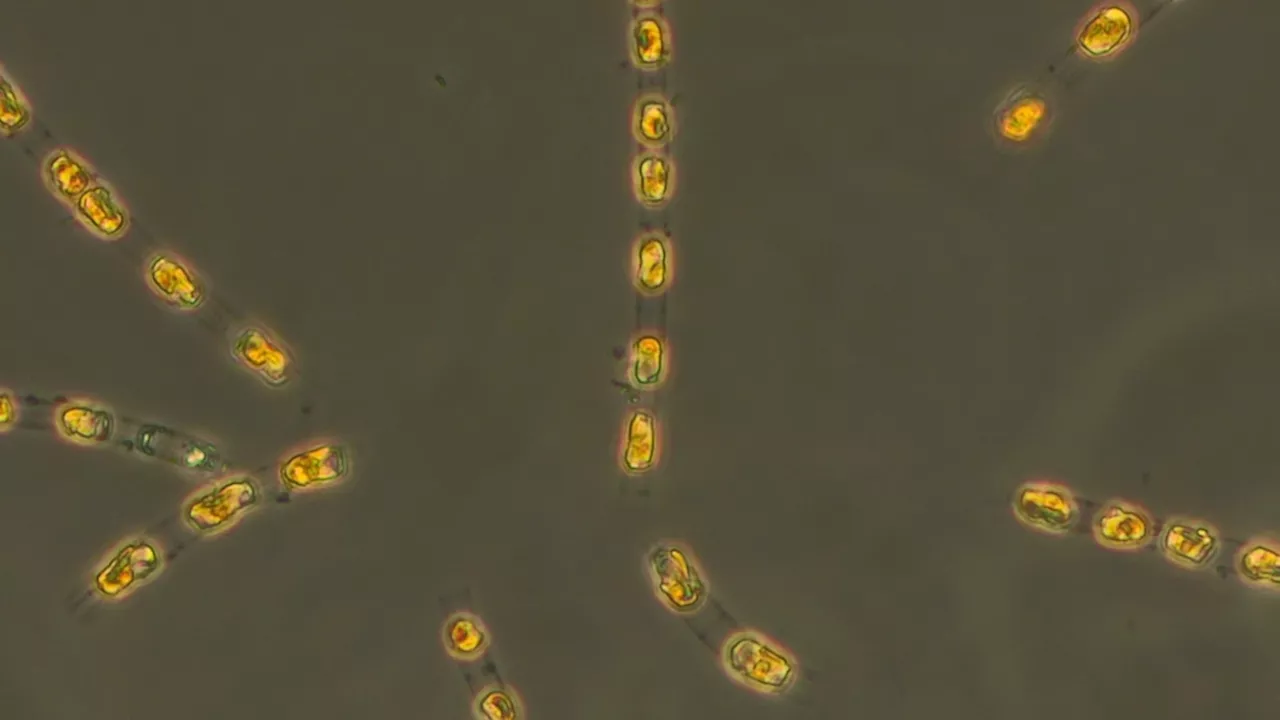 Dormant algae revived after 7,000 years beneath the Baltic Sea, researchers sayThe algae was buried in sediment beneath the Baltic Sea with no light or oxygen.
Read more »
 Researchers use AI to improve diagnosis of drug-resistant infectionsScientists have developed an artificial intelligence-based method to more accurately detect antibiotic resistance in deadly bacteria such as tuberculosis and staph. The breakthrough could lead to faster and more effective treatments and help mitigate the rise of drug-resistant infections, a growing global health crisis.
Read more »
 Researchers discover natural compound may slow ALS and dementiaA new study shows a compound found in certain fruits and vegetables could hold key to treating neurodegenerative diseases.
Read more »
 Researchers watch a single catalytic grain do work in real timeA new way to watch catalytic reactions happen at the molecular level in real time could lead to better fundamental understanding and planning of the important reactions used in countless manufacturing processes every day.
Read more »
 Researchers improve chemical reaction that underpins products from foods to fuelsA chemical reaction that's vital to a range of commercial and industrial goods may soon be initiated more effectively and less expensively.
Read more »