
Nuclear clocks could rival atomic clocks and allow for new tests of fundamental physics. A new experiment demonstrates all the ingredients needed.
Scientific clockmakers have crafted a prototype of a nuclear clock, hinting at future possibilities for using atomic nuclei to perform precise measurements of time and make new tests of fundamental physics theories.
While the definition of a “clock” is scientifically hazy, the prototype is not yet used to measure time. So it technically should be called a “frequency standard,” physicist Jun Ye says. But the work brings scientists closer to a nuclear clock than ever before. “For the first time, all essential ingredients for a working nuclear clock are contained in this work,” says Ye, of JILA in Boulder, Colo. is collecting reader questions about how to navigate our planet's changing climate.Fill out our survey Whereas atomic clocks measure time based on electrons jumping between energy levels in atoms, nuclear clocks’ timekeeping would depend on the energy levels of atomic nuclei. A certain frequency of laser light is needed for an atom or an atomic nucleus to make such a jump. The wiggling of that light’s electromagnetic waves can be used to mark time. Nuclear clocks would keep time using a variety of the element thorium, called thorium-229. Most atomic nuclei make energy leaps that are too large to be triggered by a tabletop laser. But thorium-229 has two energy levels that are close enough to each other that the transition between those two levels could serve as a clock. needed to set off that jump. It’s 2,020,407,384,335 kilohertz, Ye and colleagues report in the Sept. 5 has an uncertainty of 2 kilohertz. That’s more than a million times the precision of the best previous measurement. And it’s more than a billion times the precision to which that frequency was known just over a year ago, highlighting multiple back-to-back developments. ). A crucial component of many atomic clocks, a frequency comb creates an array of discrete frequencies of light. Using a frequency comb with thorium-229 has been a ). In the new work, Ye and colleagues compared the nuclear clock transition with that of an atomic clock with a known frequency. “This is something that will be important as a scientific application for tests of fundamental physics,” says physicist Ekkehard Peik of the National Metrology Institute in Braunschweig, Germany, who was not involved with the new research.
United States Latest News, United States Headlines
Similar News:You can also read news stories similar to this one that we have collected from other news sources.
 UN nuclear chief worried Ukraine’s raid will endanger Russia’s Kursk nuclear plantPolitical News and Conservative Analysis About Congress, the President, and the Federal Government
Read more »
 Biden Nuclear Security Official Called for 'Queering Nuclear Weapons'Sneha Nair co-authored a piece titled 'Queering nuclear weapons: How LGBTQ+ inclusion strengthens security and reshapes disarmament.'
Read more »
 N.Korea slams US' new nuclear plan, vows to boost its nuclear capabilitiesNorth Korea's Foreign Ministry says it will 'bolster its strategic strength in every way to control and eliminate all sorts of security challenges that may result from the US' dangerous nuclear posture readjustment.'
Read more »
 There is risk of nuclear accident at Russia's Kursk nuclear plant: IAEAFollowing a visit to Russia's Kursk nuclear power plant, International Atomic Energy Agency chief Rafael Grossi warns of an accident risk. Russia maintains Ukraine has been attacking the site.
Read more »
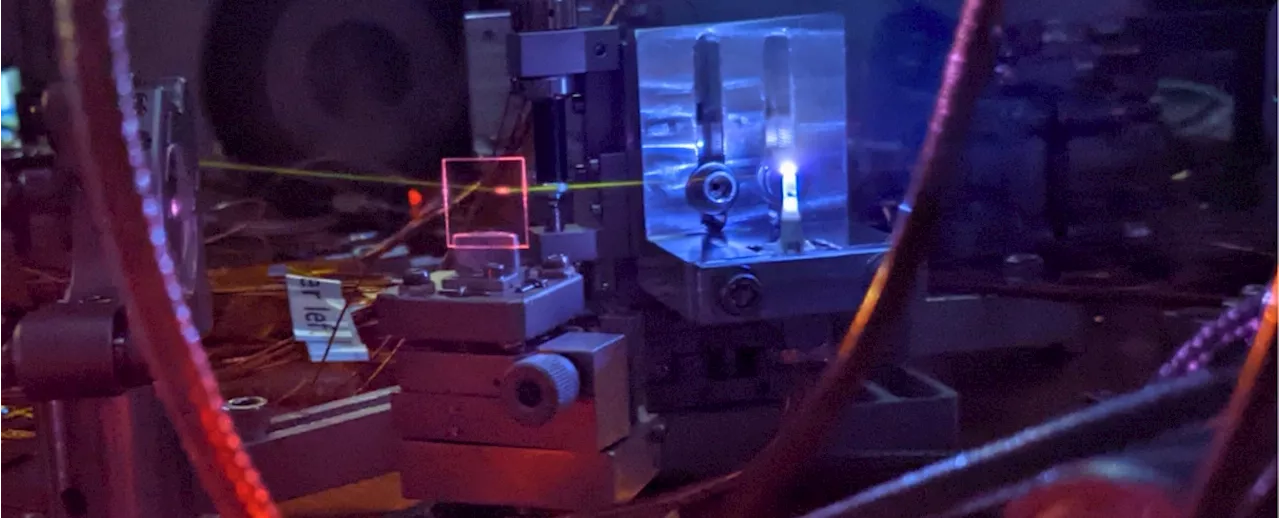 Breakthrough: Scientists Create World's First Nuclear Clock PrototypeThe Best in Science News and Amazing Breakthroughs
Read more »
 Major leap for nuclear clock paves way for ultraprecise timekeepingThe world keeps time with the ticks of atomic clocks, but a new type of clock under development—a nuclear clock—could revolutionize how we measure time and probe fundamental physics.
Read more »