
Space and astronomy news
Artist's impression of Proxima Centauri b, which orbits Alpha Centauri C in the triple-star system, Alpha Centauri. hopes to address as a team of international researchers investigated how a novel neural network-based algorithm could be used to detect Earth-like exoplanets using data from the.
This study holds the potential to help astronomers develop more efficient methods in detecting Earth-like exoplanets, which are traditionally difficult to identify within RV data due to intense stellar activity from the host star. The study notes, “Machine learning is one of the most efficient and successful tools to handle large amounts of data in the scientific field. Many algorithms based on machine learning have been proposed to mitigate stellar activity to better detect low-mass and/or long period planets. These algorithms can be classified into two categories: supervised learning and unsupervised learning. The advantage of supervised learning is that the proposed model contains a large set of variables and has the ability to produce relatively accurate predictions based on the training data.” For the study, the researchers applied their algorithm to three stars to ascertain its ability to identify exoplanets within the stellar activity data: our Sun,, with Alpha Centauri B being located approximately 4.3 light-years from Earth and Tau ceti being located approximately 12 light-years from Earth. After inserting simulated planetary signals within the algorithm, the researchers found their algorithm successfully identified simulated exoplanets with potential orbital periods ranging between 10 to 550 days for our Sun, 10 to 300 days for Alpha Centauri B, and 10 to 350 days for Tau ceti. It’s important to note that Alpha Centauri B currently has had severalAdditionally, the algorithm identified these results correspond to Alpha Centauri B and Tau ceti potentially having exoplanets approximately 4 times the size of Earth and within the habitable zones of those stars, as well. After inserting more stellar activity data into the algorithm, the researchers discovered the algorithm successfully identified a simulated exoplanet approximately 2.2 times the size of the Earth while orbiting the same distance as the Earth from our Sun. The study noted in its conclusions, “In this paper, we developed a neural network framework to efficiently mitigate stellar activity at the spectral level, to enhance the detection of low-mass planets on periods from a few days up to a few hundred days, corresponding to the habitable zone of solar-type stars.” While the study focused on finding Earth-like exoplanets within RV data, the researchers note that additional data, including transit time, phase, and space-based photometry, could be used to identify Earth-like exoplanets. They emphasize the European Space Agency’scould accomplish this, which is currently being developed and slated for launch sometime in 2026. Upon launch, it will be stationed at thelocated on the opposite side of the Earth from the Sun where it scan up to one million stars searching for exoplanets using the transit method with an emphasis on terrestrial exoplanets.by NASA has reached 5,632 as of this writing, which is comprised of 201 terrestrial exoplanets, and also provides the upcoming PLATO mission ample opportunity to discover many more terrestrial exoplanets within our Milky Way Galaxy. How will machine learning help astronomers detect Earth-like exoplanets in the coming years and decades? Only time will tell, and this is why we science!
United States Latest News, United States Headlines
Similar News:You can also read news stories similar to this one that we have collected from other news sources.
 How to Power up your Digital Marketing with Deep Learning PredictionsIn this article, we explore the impact of AI and deep learning predictions on digital marketing, providing some specific hints on how to make campaigns shine.
Read more »
 New AI-powered NoodleBot set to outperform cutting-edge robotic systemsNorthwestern engineers develop MaxDiff RL, an AI algorithm boosting robot learning by encouraging random exploration.
Read more »
 New machine learning algorithm promises advances in computingSystems controlled by next-generation computing algorithms could give rise to better and more efficient machine learning products, a new study suggests.
Read more »
 Machine Learning vs. Deep Learning: What's the Difference?Artificial intelligence technology is undergirded by two intertwined forms of automation.
Read more »
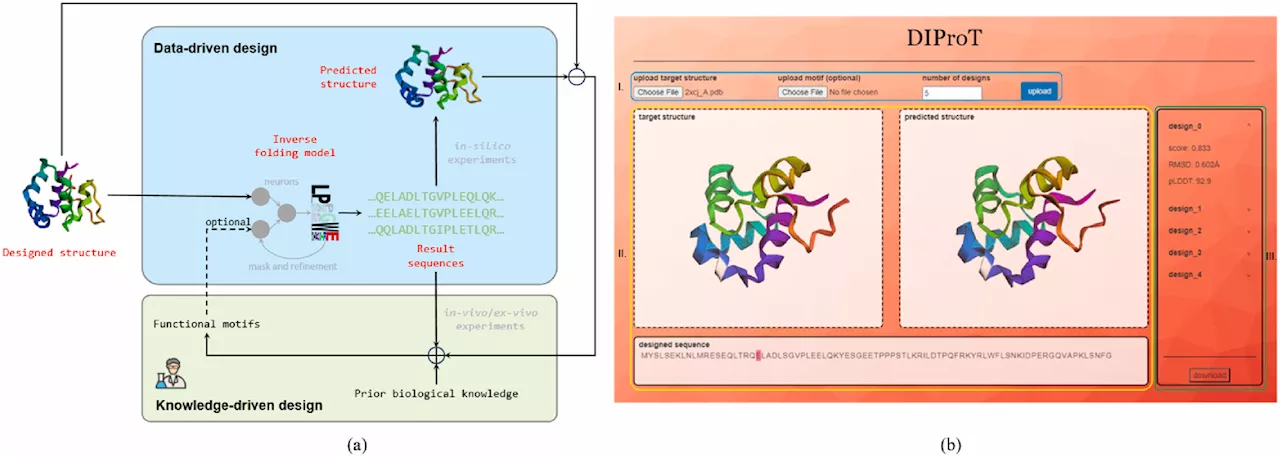 Scientists introduce DIProT—an interactive deep learning toolkit for efficient protein designScientists have developed DIProT, an innovative, user-friendly toolkit for protein design. The toolkit utilizes a non-autoregressive deep generative model to address the protein inverse folding problem, integrating human expertise into the design loop for efficient and effective protein design.
Read more »
 New deep learning model is 'game changer' for measuring embryo developmentA new deep learning model performs a task that biologists have struggled with for centuries -- how to measure the incredibly complex process of embryonic development. Scientists have shown that the AI model, known as Dev-ResNet, can identify what happens and when during embryonic development, from video.
Read more »