
From D-Wave's groundbreaking quantum annealing to IBM's superconducting qubits, discover how these revolutionary technologies are already solving real-world problems.
While still in their infancy, these powerful machines are expected to help us solve many problems by accelerating the speed at which we can process certain types of data by a factor of hundreds of millions.
But not all quantum computers are the same. Researchers are working on many different ways to apply principles of quantum mechanics to computing technology. This has led to a variety of methods, architectures and paradigms, all suited for different use cases or tasks. So here I’ll overview some of the different categories, giving a brief explanation of what makes each one unique and what it’s hoped they will achieve.refers to a new approach to computing that harnesses some of the strange and powerful properties of quantum mechanics, such as entanglement and superposition. Instead of using traditional “bits” like a classical computer, quantum computers use “qubits” that are spookily able to exist in more than one state simultaneously. This means they can potentially solve some very complex mathematical problems, such as those involving optimization problems or simulating complex real-world systems like molecular physics – far faster than existing computers.Several distinct quantum computing methodologies have emerged, each leveraging quantum properties in different ways, making them suitable for carrying out different types of computation. Here’s an overview of some of the most popular:This is a quantum computing methodology that’s particularly well-suited to solving optimization problems. These are computations that require finding the best combination of a large number of variables. It can be of use in real-world scenarios ranging from planning the most efficient route for multi-drop delivery drivers to optimizing stock portfolios. D-Wave is recognized as a leader in this field of quantum computing and has worked with companies, including Volkswagen, toOne of the most mature quantum computing methods involves building circuits from superconductive materials such as niobium or aluminum, cooled to near absolute zero temperatures. This allows qubits to exist in superposition states of both one and zero simultaneously, where they can be manipulated by microwaves. In simple terms, this lets them carry out computational logic operations in a way that lets them explore multiple possible solutions to a problem in parallel, rather than one at a time. Superconductive quantum computing is being pioneered by companies such as IBM and Google and has real-world applications in drug discovery, artificial intelligence, and encryption.This involves using positively charged atoms trapped and held within a 3D space in a way that entirely isolates it from the outside world. This means that it can be held in its superposition state for a very long time rather than decohering into one or zero. Lasers are used to switch the ions between different states as required for calculations, as well as to retrieve the information that forms the “answer” to the question that needs to be solved. Leaders in this field of quantum computing include, which has worked with the United States Air Force to create secure quantum networking technology for communicating between drones and ground stations.This involves harnessing photons, which are light waves, and manipulating them using optical components like beam splitters, lenses and mirrors. Having no mass, light waves are not affected by temperature. This means that photonic quantum computing doesn’t require super-low temperatures and a specially configured environment. Another benefit of being light beams is that the qubits encoded in photons can maintain their coherence over relatively long distances. Real-world applications for it have been found in quantum cryptography and communications, and leaders in the field includeAlthough real-world use cases for quantum computing are increasing, much of the work in the field is still purely hypothetical, and various other methods are under development in labs and academic institutions.It’s also worth noting that most quantum computing taking place today involves a hybrid model of quantum and classical methodologies. As research and development continue, there's no doubt we’ll start to see more breakthroughs in the journey towards practical, scalable and useful quantum computing.Our community is about connecting people through open and thoughtful conversations. We want our readers to share their views and exchange ideas and facts in a safe space.Insults, profanity, incoherent, obscene or inflammatory language or threats of any kindContinuous attempts to re-post comments that have been previously moderated/rejectedAttempts or tactics that put the site security at riskProtect your community.
Quantum Quantum Annealing Superconducting Quantum Computers Trapped Ion Quantum Computers Photonic Quantum Computers Future Technology
United States Latest News, United States Headlines
Similar News:You can also read news stories similar to this one that we have collected from other news sources.
 World’s first open-source trapped-ion quantum computer unveiledOQD launches the world's first open-source trapped-ion quantum computer, democratizing access to quantum technology.
Read more »
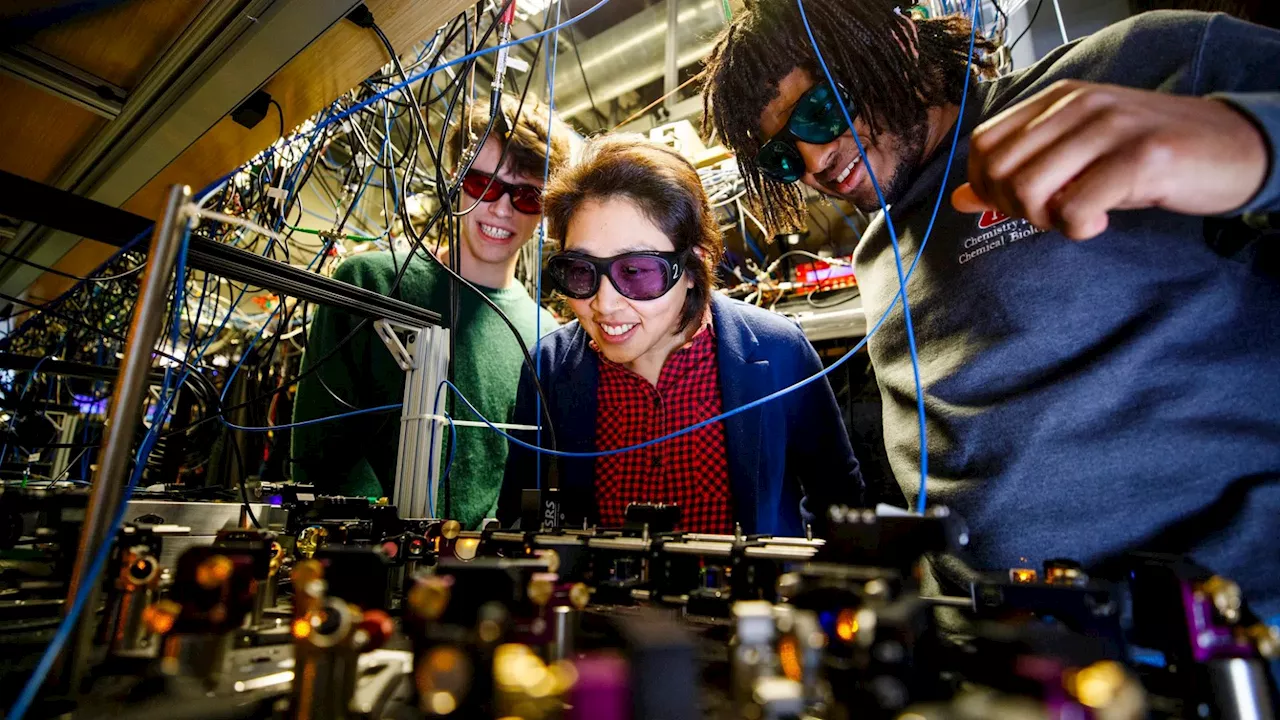 Harvard Scientists Trap Molecules for Quantum Operations, Ushering in a New Era of Quantum ComputingFor the first time, scientists have successfully trapped molecules and used them to perform quantum operations, marking a significant leap forward in the field of quantum computing. This breakthrough opens up new possibilities for building more powerful and versatile quantum computers.
Read more »
 Quantum Computer Switches Codes to Solve ErrorsResearchers have developed a method that allows a quantum computer to switch between two different error correction codes, ensuring error-free computation. This breakthrough addresses the limitations of single error correction codes and opens new possibilities for reliable quantum computing.
Read more »
 Xanadu Unveils World's First Scalable Photonic Quantum Computer PrototypeXanadu, a Canadian quantum computing company, has developed Aurora, a 12-qubit photonic quantum computer prototype. This groundbreaking achievement marks the first instance of a scalable and networked photonic quantum computer, utilizing mirrors, beam splitters, and optical fibers to manipulate photons.
Read more »
 Scientists Discover New Quantum State in 2D Semiconductors, Paving the Way for More Powerful Quantum ComputingResearchers at the Daegu Gyeongbuk Institute of Science and Technology have made a significant breakthrough in quantum computing by discovering a new quantum state within two-dimensional (2D) semiconductor chips. This discovery offers a promising path for controlling quantum information with enhanced reliability, potentially leading to more powerful and efficient quantum computers.
Read more »
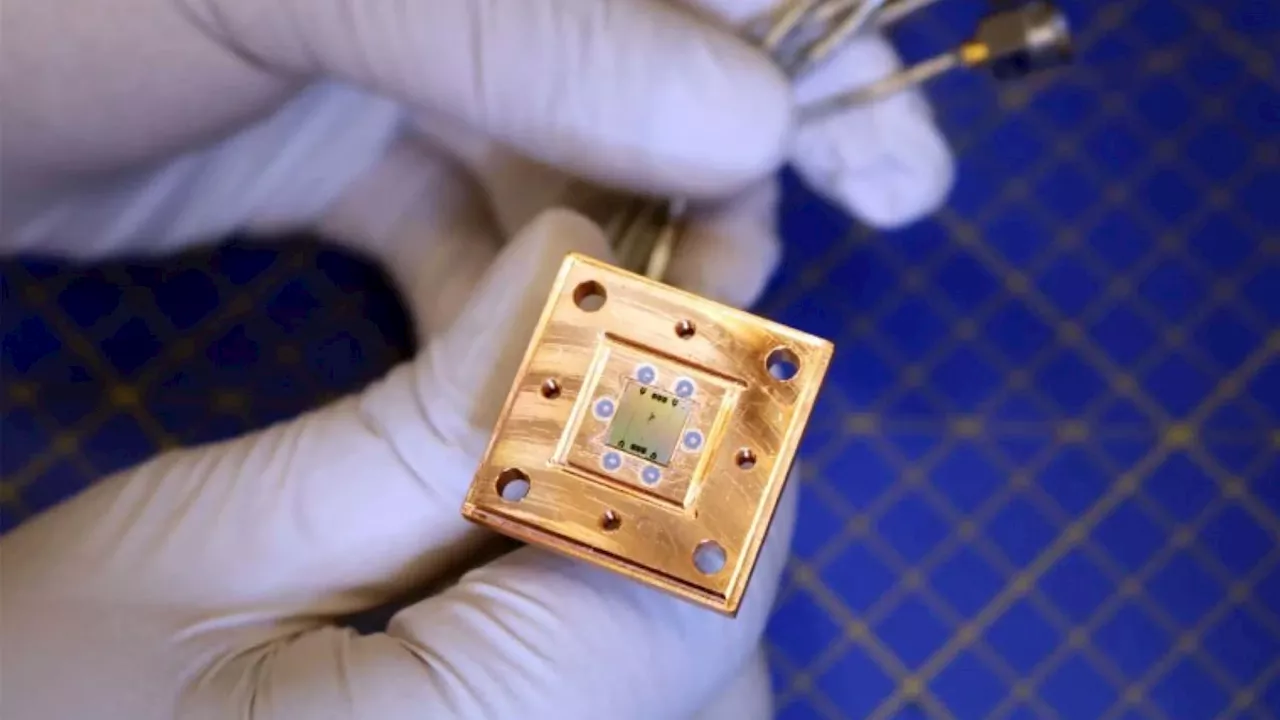 Autonomous Quantum Refrigerator Achieves Record-Low Temperature, Boosting Quantum Computer PerformanceScientists have developed a new type of autonomous quantum refrigerator that can cool qubits to a record-low temperature of 22 millikelvin. This breakthrough could significantly improve the performance and reliability of quantum computers by reducing errors caused by environmental disturbances.
Read more »