
John Koetsier covers emerging 'smart matter' tech, particularly robotics, AI, and consumer tech devices. He's written about the 'passive grenade' women's safety device as well as the first cell phone call by a customer. He hosts the TechFirst podcast and has written previously for VentureBeat, Business Insider and Inc.
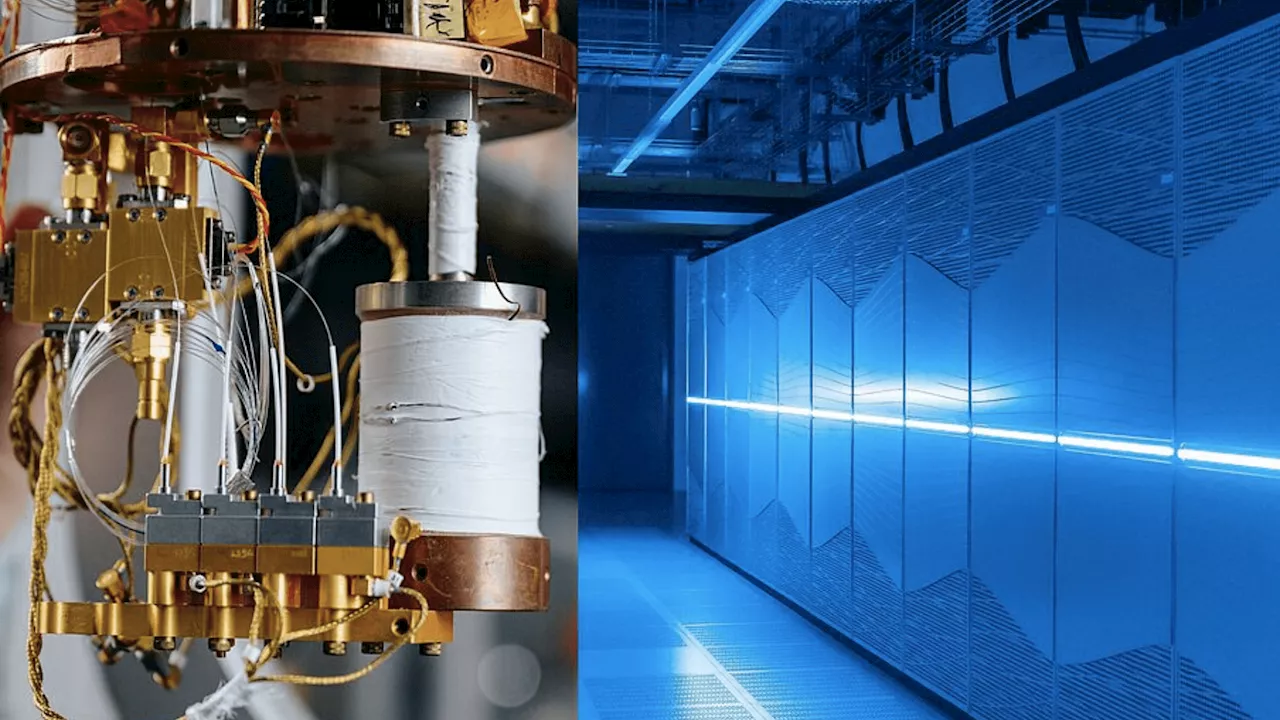
a major breakthrough in quantum computing : 24 logical qubits that can detect and correct errors. In an era when a single chip architecture in your iPhone might have 20 billion transistors, that doesn’t sound like too much of a big deal.
But Microsoft says the world’s largest logical entangled state on record. What does that mean? Where is quantum computing today? And will it ever be something that you might use day-to-day, or access via the cloud on a regular basis? Recently at Web Summit in Lisbon I had the opportunity to share a dinner with three CEOs of quantum computing companies: Horizon Quantum out of Singapore and Ireland, Oxford Ionics out of England, and IQM Quantum Computers with multiple locations across Europe. My key question at the meal: when quantum computing would stop being a gee-whiz technology that doesn’t actually do any real work, and start revolutionizing everything as the hype machine has taught us to expect. There’s some good news on that front: two of the three CEOs gave very near-term answers to functional, shipping quantum computers. The Microsoft news is extremely relevant to answer that question too, because error detection is critical in quantum computing. Quantum computing which is beset by a logical conundrum rooted in the very physics of the universe: the classical mechanics and physics that we understand in our everyday world and the quantum mechanics that Einstein mused about in his famous “God does not play dice with the universe” quote do not mix very well.“Building a quantum computer in itself is a paradox,” he said. “On one hand, you want your machine to behave quantum mechanically. And you, myself, we do not teleport. We’re not at several places at once. We live in a classical and noisy world.” That classical noise impacts quantum states, “polluting” quantum computations. Solving this decoherence is a core challenge to making truly useful quantum computers. Fortunately, there are multiple possible solutions that different quantum computing companies are testing.What's the biggest challenge in quantum computing right now?Why should we care about quantum computing now when aren't seeing very much real work being done? Can we be confident that a functioning high-capacity quantum computer is a complete gamechanger for computing ... and maybe more?What's the biggest challenge in quantum computing right now?The biggest hurdle quantum computing faces is that quantum computers are not yet useful for doing real work. A major milestone that the industry has been working towards is a first demonstration of a quantum computer solving a real world problem, one that people care about and that has economic value, significantly faster than could have been done with conventional computers. The main barrier to achieving this goal is the high error rate in current generation quantum processors, which likely needs to be overcome through error correction before a real advantage can be seen. The systems also need to be scaled up to larger qubit counts. To go from a narrow advantage on a single problem to a much broader quantum advantage, we also need to create the software infrastructure for developing more sophisticated quantum programs, and that is where we focus as a company.The biggest challenge facing quantum computing today is integration. Within the industry, you’ll often find that companies can demonstrate the individual building blocks required to make powerful quantum computers. But when combined into the large, integrated systems that are needed to make commercially- valuable quantum computers, they fall short – either in performance or scalability. The key to unlocking useful quantum computers lies in integrating all of these individual pieces into a reproducible and reliable system that can be manufactured at scale. This isn’t a science problem - it’s an engineering problem. At Oxford Ionics, we’ve tackled this by creating ultra high-performing qubits on a quantum chip that can be manufactured via standard semiconductor fabs. This means we can leverage the might of the existing semiconductor industry to scale our products. Ultimately, it’s not enough to have a powerful quantum computer that only works on its very best day – when the lab conditions are perfect or when the team of PhDs operating it are on top form. It needs to work on its worst days too, in the real world, used by real organisations. Building fully integrated, robust, and scalable systems is how we get there.The quantum computing industry has made considerable progress over the past few years, with several key milestones that are bringing us closer to reaching quantum advantage. However, as for many other emerging technologies, more investments will be needed to bolster quantum capabilities. Ensuring enough capital for the quantum computing industry will remain a key challenge. While qubit quality and gate fidelity has improved recently, scaling quantum computers to a level sufficient for solving large complex problems will take time and capital. At IQM, we are on steady progress to achieve fault-tolerant quantum computing by 2030 as shown in our recent roadmap release.Joe Fitzsimons, founder & CEO, Horizon Quantum:I think most people in the industry would say simulating chemistry, optimisation and machine learning. These are overwhelmingly favoured in industry reports. However, from my own perspective, I believe there is a much broader use for quantum computing in accelerating hard computational problems. In particular, I would expect to see quantum computers used to tackle other hard problems, such as simulating turbulent fluid flow. There is a potential to take a lot of work that currently requires lab experiments, whether in the chemistry lab, the wind tunnel or elsewhere, and do it entirely in simulation. This would open the door to much faster development cycles.We know that quantum computers promise to deliver extraordinary solutions to previously impossible-to-solve challenges. This can include a range of things across a variety of sectors ... one of the use cases we anticipate is in financial portfolio optimization – so financial institutions turning to quantum computing to help inform better and faster lending decisions, analyze investment portfolios, or make real- time market decisions. Even a 5% improvement in optimization through useful quantum computing could yield millions of dollars in profit for these institutions. Manufacturing companies may also turn to quantum computing to help optimize their supply chain – for example, identifying the most effective ways of distributing goods. These types of problems are called ‘combinatorial explosion’ problems, where adding in just a few more inputs can massively increase the compute time. Quantum computing can help reduce this burden. Finally, one of the most exciting applications is in materials science. While classical computers are limited in their ability to model materials properties, quantum computers will redefine our ability to do so. With this new capability, we’ll be empowered to design better batteries or improve pharmaceutical modelling to help identify the next-generation drug.In line with our development roadmap, we’re focusing on three key areas: quantum simulations, optimization, and quantum machine learning to achieve quantum advantage. A good example for quantum simulations is the recent work we did with Volkswagen on battery simulation. Regarding optimization, we are for example working with EDF on optimizing the schedules for power plant maintenance. Regarding quantum machine learning, we have a project with Siemens that focuses on reinforcement learning for production processes.Joe Fitzsimons, founder & CEO, Horizon Quantum: Different applications have different timescales. Chemistry is perhaps the best hope for acceleration using today’s error-prone quantum processors. This is because chemistry is naturally quantum mechanical, a natural candidate for quantum computation, and chemical reactions occur in open systems, where the environment is somewhat random. As a result, there is some chance that the random errors in today’s quantum computers can be made to look like the random environment in a chemical reaction, reducing the need for error correction. Machine learning applications will take longer to mature, since the most convincing speedups are from algorithms that require a quantum version of random access memory, which is not yet available.We expect early commercial applications to be unlocked with quantum computers that have over 200 high-fidelity qubits. At Oxford Ionics, we plan to have these systems in the hands of our customers within the next two years – but this is really the end of the beginning. We’re building technology that can not only reach this, but can also continue to scale out to hundreds of thousands of qubits.We are focusing on quantum simulations, optimization, and quantum machine learning to achieve quantum advantage from 2027.Joe Fitzsimons, founder & CEO, Horizon Quantum: The fundamental reason to care about quantum computing is that it may be computing all over again. Conventional computers have had an enormous impact on the world over the last eighty years, and in some sense quantum computers are the first real step change in what computation means since digital computers replaced rooms filled with people working with log tables.It’s important to remember that with all frontier technologies, there’s a fine line between “it does nothing” and “it does everything.” And while the difference between these two states represents years of research and development, we are fast approaching the inflection point that will see the value of quantum computing suddenly switch on. Businesses are already paying attention to the progress being made towards this takeoff point. In 2024 alone, we’ve seen some incredible milestones achieved in quantum computing performance, scale, and reliability. And while the industry has definitely gone through a few hype cycles, these achievements signal that we’re the closest we’ve ever been to unlocking commercial value through quantum computing – and the market is getting very excited as a result! We’re seeing business leaders already planning their quantum strategies today to ensure they aren’t left behind when the value switches on. These organisations are working with smaller-scale quantum computers in order to conduct the necessary research and application development, ensuring they stay ahead of the curve in the fast-approaching quantum era.As shown in the various development roadmaps of quanutm companies out there, it is becoming clear that it's only a matter of time to see the impact of quantum computing in the world. This means it is important for industry to get ready and for academia to educate the large amount of quantum engineers needed in the future. Similar as in AI, the quantum advantage moment will come and it is important to be prepared not to miss the train. Can we be confident that a functioning high-capacity quantum computer is a complete gamechanger for computing ... and maybe more?Without question, the answer is yes. Even if we focus in on just one application, code breaking, it becomes very clear that a functioning low-noise quantum computer would significantly change the world. We have known since the mid-90s that the most widely adopted public-key cryptosystems are all vulnerable to quantum attack. Using Shor’s algorithm, a quantum computer with only thousands of error- corrected qubits would be able to not just decode encrypted messages, but would be able to compromise important digital infrastructure such as DNS and Windows Update. As a result, there is an ongoing effort to develop and deploy cryptography that may be more resistant to quantum attack.If we think back to the 1950s, some very clever people were able to write down the mathematical equations required to solve incredibly complex problems – but at the time, we lacked the hardware and power required to run those computations. Fast forward to today, supercomputers have been able to solve some of those problems while others remain completely unsolved – even over 70 years later. Powerful quantum computers are the answer to this challenge. Quantum computing will represent a paradigm shift in the type of computing power we have at our disposal. Not only will quantum computing be able to solve certain types of problems faster, more efficiently, and with less power – it will revolutionise our ability to solve challenges that would otherwise be completely impossible to solve using even the most powerful supercomputer on the market today. We won’t be able to find innovative answers to these problems through marginal increases in power or more data centres – we need to fundamentally revolutionise the compute arsenal. Quantum computing is the match that will ignite that flame.Yes. However, we see this as a journey. Similar to Moore’s law in Semiconductor industries, we will see decades of advancements in quantum computing ahead of us. Every year there will be a new technology node which is more powerful than the previous on. Hence, it is not that black and white in a sense that quantum computers will suddenly work. They will get more and more powerful over time unlocking one use-case after each other. Similar to GPUs, which originally designed for gaming applications until people realized that they are also very powerful in high-performance computing, crypto mining, or AI.Clearly, there’s a lot of work yet to be done in quantum computing. However, from the two CEOs who gave actual timelines, we should have usable commercial systems starting in late 2026 or 2027.Which, if true, means that we have only a couple of years to prepare for the massive changes that are coming in cryptography, finance, manufacturing, materials science, and large-scale engineering. But the quantum computer of the near-term future is unlikely to be one that we hold in our hands like a smartphone, or place on our desks like a laptop. It’s still likely to be something very rare, very high-end, and very challenging to manufacture.Our community is about connecting people through open and thoughtful conversations. We want our readers to share their views and exchange ideas and facts in a safe space.Insults, profanity, incoherent, obscene or inflammatory language or threats of any kindContinuous attempts to re-post comments that have been previously moderated/rejectedAttempts or tactics that put the site security at riskProtect your community.
United States Latest News, United States Headlines
Similar News:You can also read news stories similar to this one that we have collected from other news sources.
 In a first, high-performance computing analyzes quantum photonics on large scaleResearchers at Paderborn University have used high-performance computing (HPC) for the first time to analyze a quantum photonics experiment on a large scale. Specifically, this involved the tomographic reconstruction of experimental data from a quantum detector.
Read more »
 Quantum Leap: Quantum and AI Will Make Hackers More Powerful Than Ever (Op-Ed)Crypto Blog
Read more »
 Breakthrough in magnetism could transform quantum computing and superconductorsA discovery by physicists is unlocking a new understanding of magnetism and electronic interactions in cutting-edge materials, potentially revolutionizing technology fields such as quantum computing and high-temperature superconductors.
Read more »
 In step forward for quantum computing hardware, physicist uncovers novel behavior in quantum-driven superconductorsA new study has uncovered important behavior in the flow of electric current through quantum superconductors, potentially advancing the development of future technologies like quantum computing.
Read more »
 Lakefront advocacy group expresses opposition to planned quantum computing campus on Far South SideLakefront advocacy group Friends of the Parks (FOTP) is expressing its opposition to a planned quantum computing campus on Chicago's Far South Side ahead of a…
Read more »
 Exceptional quantum gate with 99.9% fidelity promises errorless computingA new study from researchers at Japan’s RIKEN Center for Quantum Computing and Toshiba reveals a high-fidelity quantum gate that promises to significantly improve the performance of existing noisy intermediate-scale quantum (NISQ) devices.
Read more »